

What Counts as a Real EBITDA Add-Back? | EIN Business Brokers | Enterprise Industry Network | EINBB
Not every expense a business owner wants to remove from earnings qualifies as a legitimate EBITDA add-back. A real EBITDA add-back generally needs a clear economic reason, supporting documentation, and a credible explanation for why the expense is owner-specific, unusual, nonrecurring, or otherwise unlikely to continue under new ownership.
In this video, EIN Business Brokers (EINBB), part of the Enterprise Industry Network (EIN), explains what can count as a real EBITDA add-back when selling a business, what buyers are likely to challenge, why replacement costs and recurring expenses matter, and how sellers can build a more defensible normalized EBITDA schedule before valuation and due diligence.
What Counts as a Real EBITDA Add-Back?
A credible EBITDA add-back generally represents an expense that does not reflect the normal ongoing cost of operating the business under new ownership.
A buyer may be more likely to consider an adjustment when the seller can show that the expense is:
- Actually recorded in the financial statements.
- Clearly identifiable.
- Owner-specific or genuinely nonrecurring.
- Not necessary for ongoing operations.
- Not expected to continue after closing.
- Supported by reliable documentation.
- Not already adjusted elsewhere.
What Is an EBITDA Add-Back?
An EBITDA add-back is an expense added back to reported EBITDA when calculating normalized or adjusted EBITDA because the seller believes the cost does not represent the company’s ordinary future operating structure.
Add-backs may potentially involve:
- Owner-specific compensation adjustments.
- Certain discretionary owner expenses.
- Documented one-time legal costs.
- Nonrecurring consulting expenses.
- Unusual relocation or restructuring costs.
- Related-party normalization.
- Other transaction-specific nonrecurring expenses.
Why Buyers Care Whether an Add-Back Is Real
Buyers may use normalized EBITDA as an important input in business valuation. An unsupported adjustment can inflate the earnings figure and therefore potentially overstate business value.
Buyers may examine:
- Whether the expense truly disappears after closing.
- Whether a replacement expense will arise.
- Whether similar costs occurred in previous years.
- Whether the adjustment is supported by financial records.
- Whether the expense was necessary to generate revenue.
What Is the Basic Test for a Real EBITDA Add-Back?
A useful seller-side question is:
If a qualified buyer owns this business tomorrow, will this expense reasonably disappear without reducing the company’s ability to generate its current revenue and earnings?
If the answer is clearly yes and the seller can document why, the adjustment may be more defensible.
If the buyer must continue paying the expense, replace it with another expense, or incur a similar cost to maintain operations, the add-back may be challenged.
Does an Expense Have to Be Nonrecurring to Count?
Not always. Some owner-specific expenses may occur every year but still be normalized if they primarily benefit the owner and are not required under new ownership.
However, ordinary recurring business expenses are generally much harder to justify as add-backs.
What Does Nonrecurring Really Mean?
A nonrecurring expense is generally an unusual cost that is not expected to repeat as part of normal business operations.
Buyers may ask:
- Has this expense appeared before?
- Could the same expense arise again?
- Was it tied to a specific event?
- Has the event already ended?
- Will the buyer inherit any related obligation?
Can a One-Time Legal Expense Count as a Real Add-Back?
Potentially. A specific legal expense may qualify if it resulted from an unusual event that is complete and is not expected to recur.
The seller may need to support:
- What caused the legal expense.
- When it occurred.
- Why it is not part of normal operations.
- Whether any related liability remains.
- Invoices or professional records supporting the amount.
When Is a Legal Expense Not a Real Add-Back?
Routine legal costs may remain part of normal business operations.
A buyer may reject the add-back when:
- Legal expenses occur regularly.
- The dispute is ongoing.
- The business is in a litigation-heavy industry.
- The cost relates to ordinary contracting or compliance.
- The underlying issue remains unresolved.
Can One-Time Consulting Fees Be Added Back?
They may be considered when they relate to a clearly defined project that has ended and will not need to continue under the buyer.
Examples might include a specific:
- System implementation project.
- Temporary restructuring engagement.
- One-time strategic study.
- Completed process-improvement project.
When Are Consulting Fees Not a Real Add-Back?
A buyer may reject consulting expenses when consultants perform ongoing functions the company still needs.
Examples can include:
- Fractional management.
- Recurring bookkeeping.
- Ongoing marketing support.
- Regular IT services.
- Recurring compliance work.
Can Owner Compensation Count as an Add-Back?
Owner compensation is one of the most commonly misunderstood areas in normalized EBITDA.
A buyer may review:
- Owner salary.
- Bonuses.
- Benefits.
- Hours worked.
- Management responsibilities.
- Sales responsibilities.
- Expected replacement cost.
Why the Owner’s Full Salary Is Not Automatically an Add-Back
If the owner performs necessary work, that role still has an economic cost after the sale.
For example, if the seller currently acts as:
- Chief executive.
- General manager.
- Sales leader.
- Operations manager.
- Technical expert.
the buyer may need to hire someone to perform those duties.
A realistic normalization may therefore compare current owner compensation with the market cost of replacement management.
What Is a Replacement Management Adjustment?
A replacement management adjustment reflects the expected cost of replacing work currently performed by the owner or another individual whose compensation is not at market level.
This adjustment can reduce normalized EBITDA even when the seller initially expects an owner compensation add-back to increase earnings.
Can Excess Owner Compensation Be Added Back?
Potentially. If the owner receives compensation materially above the reasonable market cost of replacing the role, the excess portion may be considered in normalization.
The key issue is not simply what the owner was paid, but what the business realistically needs to spend after closing.
Can Below-Market Owner Compensation Lower Normalized EBITDA?
Yes. If the seller performs important work while taking compensation below what a replacement manager would cost, buyers may make a downward adjustment to reflect the higher future operating expense.
Can Family Member Compensation Be an Add-Back?
Only under the right circumstances.
Buyers may evaluate:
- Whether the family member actually works in the business.
- What responsibilities are performed.
- Whether compensation is above or below market.
- Whether the position remains necessary.
- What replacement cost would be.
Why Family Payroll Is Not Automatically Discretionary
A family relationship does not automatically make the compensation removable.
If the employee performs necessary work, some level of compensation will usually remain part of normalized operating expenses.
Can Personal Owner Expenses Be Real Add-Backs?
Certain clearly documented owner-specific expenses may potentially qualify when they primarily benefit the owner and are not required for the company to operate.
Examples may include certain:
- Owner-specific travel.
- Personal automobile expenses.
- Personal insurance benefits.
- Other documented discretionary owner expenses.
What Makes a Personal Expense Defensible as an Add-Back?
The seller should generally be able to show:
- The expense is actually in the business financials.
- The expense primarily benefited the owner personally.
- The buyer will not need to incur it.
- The expense is clearly documented.
- The expense has not been adjusted elsewhere.
Can Travel Be Added Back?
Owner-specific personal travel may potentially qualify, but business travel generally does not.
A buyer may retain expenses related to:
- Customer visits.
- Sales travel.
- Supplier meetings.
- Industry conferences.
- Operational travel.
Can Automobile Expenses Be Added Back?
Potentially, but only to the extent the costs are owner-specific and not required for operating the company.
Buyers may ask:
- Is the vehicle necessary for business operations?
- Who uses it?
- Will another vehicle be needed after closing?
- Are lease or financing payments ongoing?
Can Owner-Specific Insurance Be Added Back?
Certain owner-specific policies or benefits may potentially be adjusted, but insurance needed to operate the business normally remains an ongoing expense.
The buyer may retain costs for:
- General liability insurance.
- Property insurance.
- Workers’ compensation.
- Professional liability coverage.
- Other required operating insurance.
Can Charitable Contributions Count as Add-Backs?
Some discretionary charitable contributions may potentially be considered, but the buyer may examine whether the contributions are genuinely discretionary or connected to marketing, community relationships, contracts, or business development.
Can Related-Party Rent Be Adjusted?
Yes. When the business leases real estate from the owner or another related party, buyers may normalize the rent to market terms.
They may compare:
- Current rent.
- Market rent.
- Property size.
- Location.
- Lease terms.
- Expected post-closing rent.
Is Related-Party Rent Always an Add-Back?
No. Related-party rent generally requires normalization rather than automatic removal.
If current rent is above market, normalized EBITDA may increase. If current rent is below market, EBITDA may decrease.
Can Related-Party Management Fees Be Adjusted?
They may need normalization if the company pays an affiliated entity for services.
Buyers may ask:
- What services are provided?
- Are those services necessary?
- Is the pricing market-based?
- Will the buyer need similar services after closing?
Can One-Time Relocation Costs Be Real Add-Backs?
Potentially. If a business recently moved locations and incurred clearly identifiable one-time moving expenses, those costs may be considered.
However, ongoing higher rent, staffing, utilities, or operating expenses created by the new location generally remain part of normalized operations.
Can Restructuring Costs Be Added Back?
A specific completed restructuring event may create legitimate one-time costs.
Buyers may still evaluate whether:
- More restructuring is required.
- Severance costs will continue.
- New management needs to be hired.
- Operational problems remain unresolved.
Can Severance Be a Real Add-Back?
A specific unusual severance payment may potentially qualify when it arose from a one-time event and is not part of a recurring turnover pattern.
Repeated severance costs may be treated differently.
Can Recruiting Costs Be Added Back?
An unusually large, one-time executive search may potentially be reviewed as a normalization item.
Routine recruiting costs usually remain part of normal operations when the company regularly hires employees.
Can One-Time Technology Implementation Costs Be Added Back?
Potentially. A completed system implementation, migration, or conversion may create one-time expenses.
However, ongoing technology costs generally remain.
These can include:
- Software subscriptions.
- Hosting.
- Maintenance.
- Licensing.
- IT support.
- Cybersecurity services.
Can Website Development Be an Add-Back?
It depends on the circumstances. A large one-time rebuild may be evaluated differently from recurring website maintenance, marketing, hosting, or digital operations.
Buyers may also consider whether continued digital investment is required to maintain revenue.
Can Marketing Expenses Be Real Add-Backs?
Ordinary marketing expenses are generally part of the cost of generating revenue.
A specific unusual campaign may be evaluated, but buyers may ask whether comparable marketing spending will still be needed after closing.
Why Cutting Marketing From EBITDA Can Be Misleading
If the company needs marketing to replace customers and generate sales, eliminating that expense from normalized EBITDA may overstate sustainable earnings.
Can Growth Investments Be Added Back?
Not automatically.
A seller may describe expenses as growth investments, but a buyer may retain them when continued investment is necessary to achieve the revenue and earnings being presented.
Why Future Growth Spending Is Important
A buyer may ask whether the current EBITDA level can be maintained without continuing to spend on:
- Salespeople.
- Marketing.
- Technology.
- Product development.
- New locations.
- Additional management.
Can Research and Development Costs Be Added Back?
Depending on the business, R&D may be a normal recurring requirement rather than a one-time expense.
A buyer may reject an add-back if continued product development or innovation is necessary to maintain the company’s competitive position.
Can Bad Debt Be Added Back?
A truly unusual bad debt event may potentially be considered, but buyers may examine whether customer defaults or write-offs are part of the normal economics of the business.
They may review:
- Historical write-offs.
- Accounts receivable aging.
- Customer concentration.
- Collection practices.
- Credit policies.
Can Inventory Write-Offs Be Added Back?
An unusual inventory event may potentially qualify, but recurring obsolescence or shrinkage may represent an ordinary business cost.
Buyers may examine multiple years of:
- Inventory write-offs.
- Obsolescence.
- Shrinkage.
- Inventory turnover.
- Slow-moving stock.
Can Repairs Be Added Back?
An exceptional one-time repair may potentially be considered, but routine maintenance generally remains an ongoing operating expense.
Buyers may also investigate whether a large repair reflects deferred maintenance rather than an unusual event.
Why Deferred Maintenance Is Not a Clean Add-Back
If the company postponed normal maintenance and then incurred a large repair, the buyer may conclude that the cost reflects a normal economic requirement rather than a true one-time expense.
Can Business Sale Preparation Costs Be Added Back?
Certain professional expenses incurred specifically because the business is being prepared for or sold may potentially be considered nonrecurring, depending on accounting treatment and transaction circumstances.
These can include certain transaction-specific:
- Legal fees.
- Accounting fees.
- Advisory fees.
- Other professional costs.
Why Transaction Expenses Need Clear Identification
The seller should separate ordinary recurring professional expenses from costs incurred specifically because of the sale process.
What Usually Does Not Count as a Real EBITDA Add-Back?
Ordinary expenses required to operate the business are generally difficult to defend as add-backs.
Common examples can include:
- Normal payroll.
- Routine rent.
- Recurring marketing.
- Regular insurance.
- Software subscriptions.
- Normal maintenance.
- Routine accounting.
- Regular legal costs.
- Utilities.
- Ordinary operating supplies.
Why Necessary Operating Expenses Are Not Real Add-Backs
If the buyer must continue paying an expense to maintain current revenue, customers, employees, or operations, removing it from normalized EBITDA may overstate future earnings.
Why Recurring Expenses Are a Warning Sign
An expense described as one-time becomes harder to defend when similar costs appear year after year.
Buyers may compare several periods to determine whether a cost is truly unusual.
Can a Cost Be Recurring but Still Owner-Specific?
Yes. Some owner-specific discretionary costs may recur annually but still be removed if the buyer will not need to incur them.
This is why buyers evaluate both frequency and economic necessity.
What Is the Difference Between an Add-Back and a Cost Saving?
An add-back generally relates to historical expenses that do not represent future normalized operations.
A cost saving is usually a future improvement the buyer hopes to achieve.
These are not the same.
Why Future Cost Savings Usually Do Not Count as Historical Add-Backs
Buyers may reject adjustments based on actions that have not yet occurred.
Examples include:
- Future layoffs.
- Expected vendor discounts.
- Possible rent reductions.
- Planned automation.
- Future insurance savings.
- Unimplemented efficiency programs.
What Are Pro Forma Adjustments?
Pro forma adjustments generally reflect expected future operating changes rather than historical normalization.
Buyers may analyze them separately from EBITDA add-backs.
Why Buyer Synergies Are Not Seller Add-Backs
A strategic buyer may be able to eliminate duplicate overhead, combine facilities, consolidate management, or negotiate better purchasing terms after the acquisition.
Those synergies may be valuable to the buyer, but they do not necessarily represent the standalone normalized EBITDA of the business being sold.
Why Duplicate Add-Backs Are Not Real Add-Backs
An expense should generally be normalized only once.
Double-counting can occur when:
- The same expense appears in multiple categories.
- Owner compensation is adjusted twice.
- A financial statement already excludes the expense.
- An item appears in both an add-back schedule and another normalization entry.
How Duplicate Add-Backs Hurt Seller Credibility
A single duplicate adjustment can cause buyers to examine every other add-back more aggressively.
Careful reconciliation is therefore important before normalized EBITDA is presented.
Why Downward Adjustments Matter When Determining Real EBITDA
Normalization is not only about increasing EBITDA.
Buyers may identify expenses that need to be added into the business after closing.
Potential downward adjustments can include:
- Market-rate management compensation.
- Market-rate rent.
- Required additional employees.
- Understated insurance.
- Missing software costs.
- Other necessary recurring expenses.
Why a Realistic EBITDA Analysis Includes Both Directions
A balanced normalization schedule can increase credibility because it focuses on sustainable earnings rather than simply producing the highest possible EBITDA number.
What Documentation Makes an Add-Back More Credible?
Sellers should be prepared to support each proposed adjustment.
Documentation may include:
- General ledger records.
- Invoices.
- Receipts.
- Payroll records.
- Bank records.
- Contracts.
- Tax records.
- Written explanations.
- Evidence of the event creating the expense.
Why the General Ledger Is Important
The general ledger helps buyers trace an adjustment directly to the company’s accounting records.
It can also reveal whether similar expenses occurred in prior periods.
Why Multi-Year Financial History Matters
A buyer may review several years of expenses to determine whether an item described as nonrecurring is actually recurring.
A seller claiming a one-time $50,000 expense may face questions if similar expenses appear every year.
Why Monthly Financial Statements Matter
Monthly records can help buyers understand when an expense occurred, whether it was isolated, and how it affected the company’s earnings during that period.
Why Tax Returns May Be Compared With Add-Back Schedules
Buyers may compare internal financial statements, tax returns, and normalization schedules to determine whether the earnings presentation is consistent.
Material discrepancies should be understood before formal due diligence begins.
How Should Sellers Present Real EBITDA Add-Backs?
A clear adjustment schedule can show the bridge from reported EBITDA to normalized EBITDA.
For each item, sellers may provide:
- Expense description.
- Dollar amount.
- Financial statement period.
- Reason for adjustment.
- Why the cost will not recur.
- Supporting documentation.
What Is an EBITDA Bridge?
An EBITDA bridge shows how the seller moves from reported earnings to normalized earnings.
A simplified format might include:
- Reported EBITDA.
- Plus accepted owner-specific expenses.
- Plus accepted nonrecurring expenses.
- Minus replacement management costs.
- Minus other necessary normalization items.
- Equals normalized EBITDA.
Why Buyers Prefer a Clear EBITDA Bridge
A transparent schedule helps buyers understand exactly what is being adjusted and why.
It also makes financial due diligence more efficient than presenting one unexplained adjusted EBITDA number.
What Is a Quality of Earnings Review?
In some transactions, buyers or financial advisors may conduct a quality of earnings analysis to test the accuracy and sustainability of reported and adjusted EBITDA.
The review may examine:
- Revenue recognition.
- Customer concentration.
- Gross margins.
- Owner compensation.
- EBITDA add-backs.
- Working capital.
- Accounting policies.
- Historical earnings trends.
How Can a Quality of Earnings Review Change Add-Backs?
A buyer’s review may:
- Accept an adjustment.
- Reject it entirely.
- Accept only part of it.
- Add a downward adjustment.
- Identify additional normalization items.
Why Buyers May Accept Only Part of an Add-Back
An expense may contain both discretionary and necessary components.
For example, an owner’s compensation may be above market, but the buyer may still need to retain a substantial replacement salary.
The buyer may therefore accept only the excess portion as an adjustment.
Why Sustainable EBITDA Matters More Than Maximum EBITDA
The purpose of normalization is to estimate realistic ongoing earnings, not simply to produce the highest possible number.
Sustainable EBITDA is generally supported by:
- Stable revenue.
- Healthy margins.
- Recurring customers.
- Strong management.
- Transferable operations.
- Reliable financial reporting.
- Consistent cash generation.
How Do Real Add-Backs Affect Business Valuation?
If buyers accept legitimate adjustments, normalized EBITDA may increase.
Because many valuations use an EBITDA multiple, a higher accepted earnings base may increase indicative business value.
Actual valuation still depends on company risk, market conditions, growth, buyer demand, and transaction-specific factors.
Can a Small Add-Back Have a Large Valuation Effect?
Potentially. When an EBITDA multiple is applied, an accepted adjustment can have an amplified effect on indicative enterprise value.
This is one reason buyers scrutinize add-backs carefully.
Why Add-Backs Do Not Determine the Valuation Multiple
Normalized EBITDA establishes an earnings base, but the multiple reflects broader company quality and risk.
The multiple may still be affected by:
- Customer concentration.
- Recurring revenue.
- Owner dependence.
- Management strength.
- Growth potential.
- Industry risk.
- Business size.
- Buyer competition.
Why a Real Add-Back Cannot Fix Customer Concentration
A company may have legitimate add-backs and strong normalized EBITDA but still carry significant risk if one customer produces a large portion of earnings.
Buyers can accept the EBITDA calculation while applying a more conservative valuation multiple.
Why Add-Backs Cannot Fix Owner Dependence
The seller may successfully normalize owner compensation while the business remains highly dependent on the owner’s customer relationships, sales ability, technical expertise, or leadership.
Those transferability risks can still affect buyer interest and valuation.
Why Strong Adjusted EBITDA Must Still Convert Into Cash Flow
Buyers may compare normalized EBITDA with actual cash generation.
Cash flow can be affected by:
- Accounts receivable.
- Inventory.
- Working capital.
- Capital expenditures.
- Debt obligations.
- Seasonality.
Why Capital Expenditures Are Not EBITDA Add-Backs
Capital expenditures are treated differently from ordinary EBITDA expenses, but buyers still consider how much cash the business needs to reinvest in equipment, technology, vehicles, or facilities.
A business with strong EBITDA but heavy recurring capital expenditure needs may still receive a more conservative valuation.
Why Working Capital Is Separate From EBITDA Add-Backs
Working capital generally involves operating assets and liabilities such as:
- Accounts receivable.
- Inventory.
- Accounts payable.
Working capital does not normally become an EBITDA add-back, but it can materially affect transaction economics and seller proceeds.
How Real Add-Backs Affect Acquisition Financing
Lenders may evaluate normalized cash flow when determining how much acquisition debt the business can support.
If the lender accepts fewer add-backs than the seller expects, financing may be affected.
Why Lenders May Reject Seller Add-Backs
Lenders may apply conservative underwriting standards and may reject adjustments that appear:
- Speculative.
- Poorly documented.
- Recurring.
- Dependent on future cost savings.
- Uncertain after ownership changes.
How Rejected Add-Backs Can Affect Buyer Financing
Lower lender-adjusted EBITDA can potentially result in:
- Lower debt capacity.
- Higher buyer equity requirements.
- More seller financing.
- Lower purchase price.
- A revised deal structure.
How Add-Back Disagreements Can Affect a Letter of Intent
A buyer may submit an offer based on a specific normalized EBITDA figure.
Before agreeing to an LOI, sellers should understand:
- Which EBITDA period is being used.
- Which add-backs were accepted.
- What multiple supports the offer.
- Whether valuation remains subject to financial diligence.
- Whether current performance could change the offer.
Can Add-Backs Be Renegotiated After an LOI?
Yes. Buyer due diligence may cause normalized EBITDA to change if proposed adjustments are rejected or new expenses are identified.
This can lead to:
- Price renegotiation.
- Seller financing.
- Earnouts.
- Additional escrow.
- Other structural changes.
Can Unsupported Add-Backs Cause a Buyer to Walk Away?
Potentially. If the seller’s adjusted EBITDA proves materially overstated, the buyer may lose confidence in the financial presentation, reduce the offer, experience financing problems, or decide not to proceed.
Why Seller Credibility Is Important
A conservative, well-supported EBITDA schedule can be more persuasive than an aggressive schedule filled with questionable adjustments.
Buyers generally respond better to:
- Clear documentation.
- Consistent financial records.
- Reasonable assumptions.
- Transparent explanations.
- Balanced normalization.
What Are the Biggest Fake or Weak Add-Back Warning Signs?
Buyers may become skeptical when they see:
- Large unsupported round-number adjustments.
- Recurring expenses described as one-time.
- Owner salary removed with no replacement cost.
- Normal marketing removed from earnings.
- Routine maintenance added back.
- Future savings treated as historical earnings.
- Duplicate adjustments.
- No supporting documents.
- Adjustments that change every time financials are presented.
What Questions Should Sellers Ask About Every Add-Back?
Before including an adjustment, sellers can ask:
- Did this expense actually occur?
- Can I identify it in the accounting records?
- Why will it disappear?
- Will the buyer need a replacement expense?
- Has the expense occurred in previous years?
- Is it necessary to maintain current revenue?
- Can I document the amount?
- Have I already adjusted it elsewhere?
How Can Sellers Prepare Real Add-Backs Before Selling?
Business owners can review normalization before entering the market.
- Reconcile financial records.
- Review several years of expenses.
- Identify genuine owner-specific costs.
- Identify truly nonrecurring events.
- Calculate owner replacement costs.
- Normalize related-party transactions.
- Remove ordinary recurring expenses from the add-back list.
- Eliminate duplicate adjustments.
- Identify downward normalization items.
- Document every proposed adjustment.
- Prepare an EBITDA bridge.
Why Sellers Should Review Add-Backs Before Setting the Asking Price
If the expected business valuation depends on adjustments buyers are unlikely to accept, the seller may enter the market with unrealistic expectations.
Reviewing add-backs early can help reduce:
- Valuation gaps.
- Buyer skepticism.
- Financing problems.
- Due diligence disputes.
- Late-stage price reductions.
- Failed transactions.
How EIN Business Brokers Helps Sellers Evaluate EBITDA Add-Backs
EIN Business Brokers (EINBB), under the Enterprise Industry Network (EIN), works with business owners preparing to sell, understanding normalized earnings, evaluating business value, identifying buyer concerns, and positioning companies for qualified acquisition buyers.
- Business valuation and market positioning.
- Seller readiness and exit planning.
- Review of normalized earnings and value drivers.
- Identification of potential EBITDA adjustment concerns.
- Confidential buyer outreach.
- Buyer qualification.
- Offer and Letter of Intent evaluation.
- Transaction-structure and negotiation support.
- Due diligence and closing coordination.
If you are considering selling your business, determining which EBITDA add-backs are genuinely defensible before going to market can help establish more realistic normalized earnings, strengthen buyer confidence, support valuation discussions, and reduce avoidable surprises during financial due diligence.
Which of Your EBITDA Add-Backs Would Buyers Actually Accept?
A real add-back should have a defensible reason, clear documentation, and a credible explanation for why the cost will not remain under new ownership. Review normalized earnings and potential buyer challenges before selling with EIN Business Brokers.
Frequently Asked Questions
What counts as a real EBITDA add-back?
A real EBITDA add-back generally represents an identifiable and supportable expense that is owner-specific, genuinely nonrecurring, or otherwise not expected to remain under new ownership. Buyers usually evaluate whether the expense is necessary for ongoing operations and whether a replacement cost exists.
Can the owner’s entire salary be added back to EBITDA?
Not necessarily. If the owner performs necessary management, sales, operational, or technical duties, the buyer may include the realistic market cost of replacing those responsibilities when calculating normalized EBITDA.
Do one-time expenses automatically qualify as EBITDA add-backs?
No. Buyers may examine whether the expense is truly nonrecurring, whether the underlying issue has ended, whether similar costs occurred previously, and whether the expense is supported by documentation.
What expenses usually do not count as EBITDA add-backs?
Normal payroll, routine rent, recurring marketing, ongoing software, regular insurance, ordinary maintenance, normal professional fees, utilities, and other costs required to maintain operations generally do not qualify simply because a seller wants to remove them.
Why do buyers reject EBITDA add-backs?
Buyers may reject add-backs that are recurring, speculative, duplicated, poorly documented, necessary to generate current revenue, or likely to be replaced by another cost after closing.
What documentation should support a real EBITDA add-back?
Useful support can include general ledger records, invoices, receipts, payroll information, contracts, tax records, bank records, and written explanations showing what the expense was and why it should not continue under new ownership.
How can EIN Business Brokers help evaluate EBITDA add-backs?
EIN Business Brokers can support sellers with normalized earnings review, business valuation, seller readiness, buyer outreach, buyer qualification, offer and LOI evaluation, negotiation, due diligence coordination, and transaction support through closing.
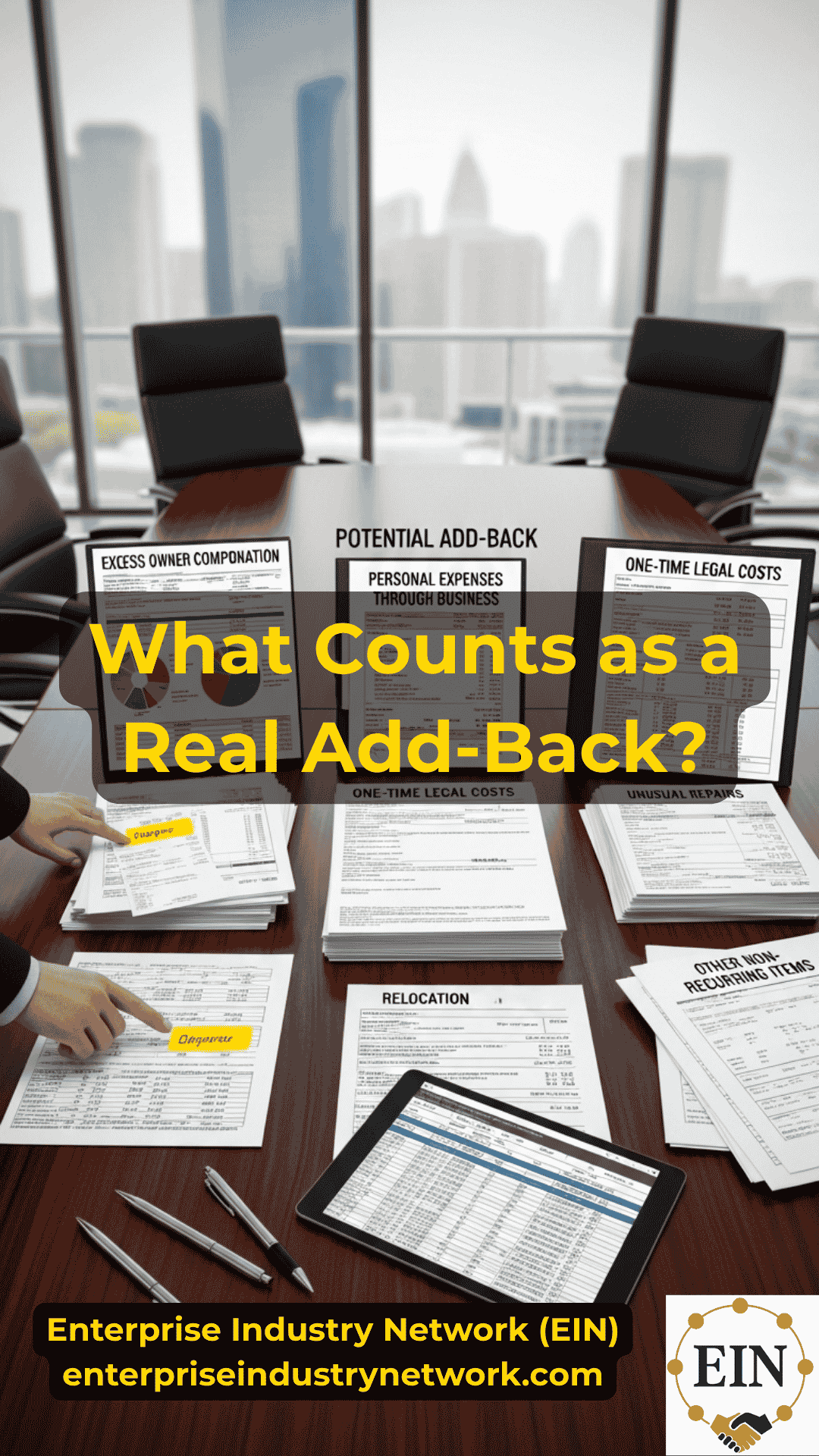 A defensible EBITDA add-back should have a clear economic reason, reliable documentation, and a credible explanation for why the expense will not remain under new ownership.