

Warehouse team using robotics-as-a-service for inventory movement

Robotics-as-a-Service Is Expanding Automation Access for Mid-Market Companies

Robotics-as-a-service is expanding automation access for mid-market companies. Instead of purchasing robotic systems outright, businesses may use subscription, lease, or managed-service models to access automation capacity. This approach can reduce upfront capital requirements and allow companies to test robotics in warehousing, manufacturing, fulfillment, inspection, cleaning, logistics, and facility operations. Businesses still need to evaluate workflow…

Read More
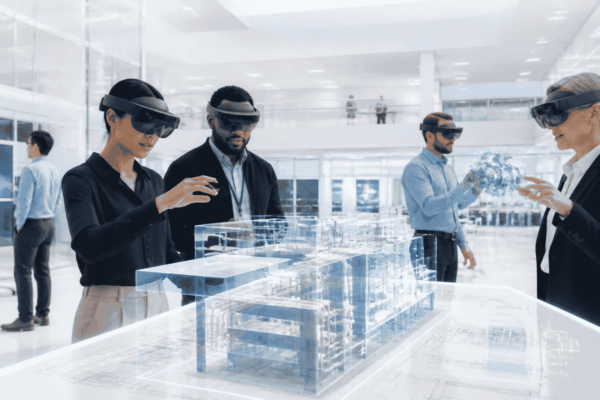
Enterprise team using spatial computing for operational planning and training

Spatial Computing Is Moving From Demonstration to Enterprise Operations

Spatial computing is moving from demonstration to enterprise operations. Organizations are beginning to use augmented reality, mixed reality, three-dimensional visualization, and location-aware digital tools for practical business activities. Applications may include employee training, equipment maintenance, facility design, remote technical support, product development, warehouse planning, and customer demonstrations. These tools can place digital information directly within…

Read More
Privacy-enhancing technology dashboard supporting secure data collaboration

Privacy-Enhancing Technologies Are Becoming Important for Secure Data Collaboration

Privacy-enhancing technologies are becoming important for secure data collaboration. As businesses work with partners, vendors, platforms, and AI systems, they need ways to share insights without unnecessarily exposing sensitive information. These technologies may support encrypted analysis, anonymization, secure computation, controlled access, and privacy-preserving data workflows. They are especially relevant when companies collaborate across finance, healthcare,…

Read More
Synthetic data dashboard supporting safe AI model development

Synthetic Data Is Emerging as a Practical Tool for Safer AI Development

Synthetic data is emerging as a practical tool for safer AI development in 2026. Businesses are exploring artificially generated data that reflects useful patterns without exposing sensitive customer, employee, or operational information. This approach can help organizations test models, train systems, improve analytics, and validate workflows while reducing privacy risks associated with real-world data. However,…

Read More
Enterprise Automation and AI in Digital Operations

Enterprise Automation Platforms Are Converging With AI to Reshape Digital Operations

Enterprise automation platforms are converging with AI to reshape digital operations in 2026. Businesses are moving beyond simple task automation toward connected platforms that coordinate workflows, data, approvals, reporting, and decision support. AI-enhanced automation can help identify bottlenecks, recommend next steps, summarize information, route work, and improve execution speed across teams. However, successful adoption requires…

Read More
Secure enterprise data infrastructure supporting emerging technologies

Secure Data Infrastructure Is Becoming Foundational for Emerging Technology Adoption

Secure data infrastructure is becoming foundational for emerging technology adoption in 2026. Businesses exploring AI, automation, analytics, digital twins, and advanced platforms need reliable data systems before these technologies can deliver value. Without secure and well-organized data infrastructure, companies may face risks related to privacy, accuracy, compliance, cybersecurity, and poor decision-making. Technology adoption becomes harder…

Read More
Executives reviewing quantum-ready enterprise technology roadmap

Quantum-Ready Planning Is Entering Enterprise Technology Conversations

Quantum-ready planning is entering enterprise technology conversations in 2026. While many businesses are not yet using quantum computing directly, leaders are beginning to understand how future computing advances may affect security, data processing, optimization, and innovation. Early planning does not require immediate large-scale adoption. Instead, it involves monitoring developments, evaluating future risks, and identifying areas…

Read More
Digital twin dashboard simulating business and factory operations

Digital Twin Technology Is Helping Businesses Simulate Decisions Before Execution

Digital twin technology is gaining traction in 2026 as businesses look for better ways to simulate decisions before execution. A digital twin creates a virtual model of a physical asset, process, facility, or operating system. Businesses can use these models to test scenarios, forecast outcomes, identify risks, and improve planning. This reduces uncertainty before major…

Read More
Edge computing network processing real-time data

Edge Computing Is Enabling Faster Data Processing and Real-Time Business Decisions

Edge computing is transforming how businesses process data in 2026. By bringing computation closer to data sources, companies can achieve faster processing and real-time insights. This technology reduces latency and improves efficiency, making it ideal for applications requiring immediate responses. Businesses adopting edge computing are gaining a competitive advantage through faster decision-making and improved operational…

Read More
Futuristic technology ecosystem with AI and digital transformation

Emerging Technologies Are Creating New Competitive Advantages Across Industries

Emerging technologies are redefining how businesses compete in 2026. Innovations in AI, blockchain, and automation are creating new opportunities for growth and efficiency. Companies that adopt these technologies early are gaining competitive advantages by improving processes, reducing costs, and enhancing customer experiences. However, successful adoption requires strategic planning and alignment with business objectives. Support from…

Read More