

From Execution Gaps to Scalable Systems: A Consulting Blueprint for Performance in 2026
From Execution Gaps to Scalable Systems: A Consulting Blueprint for Performance in 2026
Most businesses don’t fail because they lack ambition. They stall because execution becomes inconsistent. By 2026, performance expectations are higher, margins are under pressure, and operational inefficiency is no longer a minor inconvenience—it’s a value killer. When teams are busy but outcomes are unpredictable, the problem is rarely effort. The problem is structure.
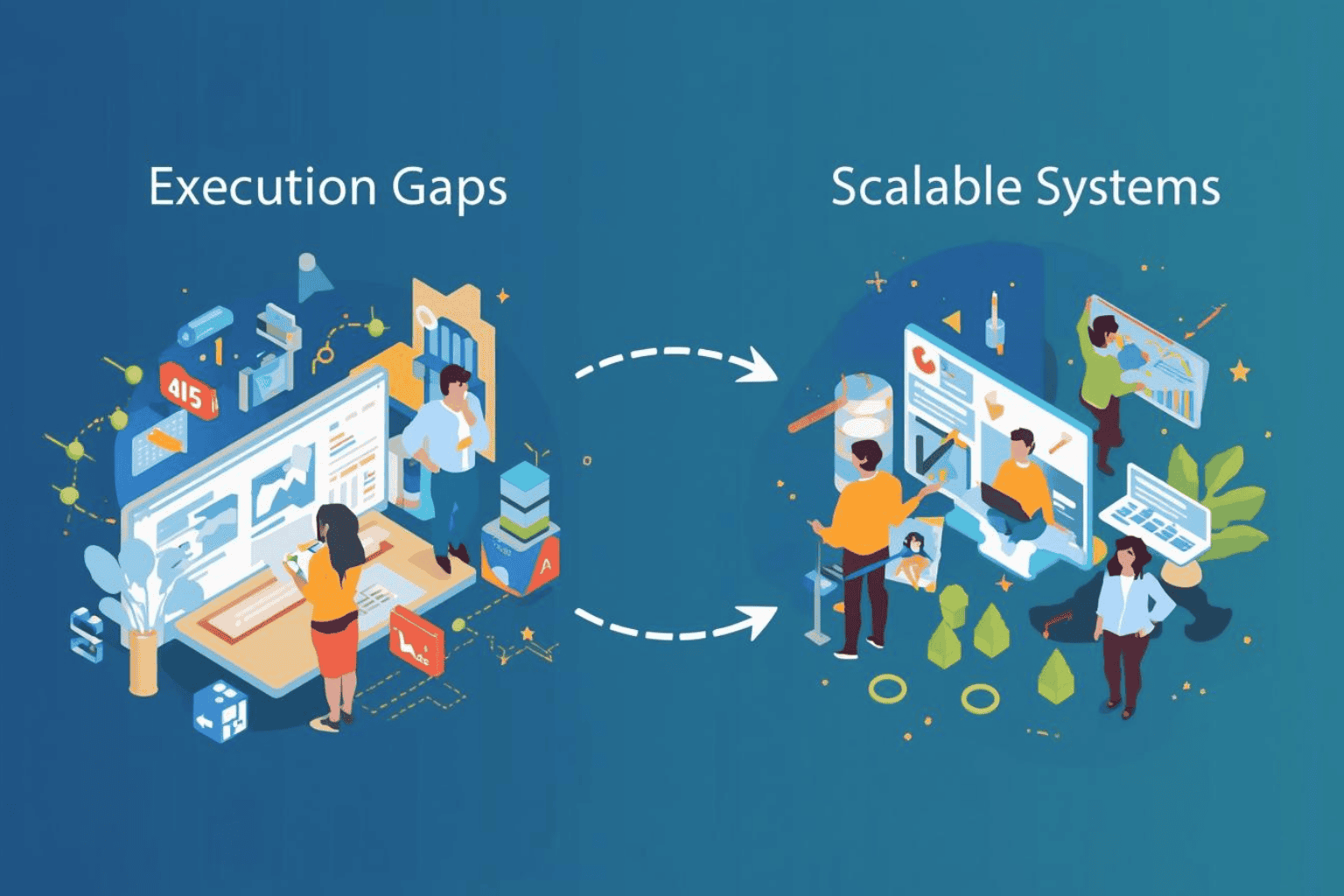
Business consulting exists to convert operational complexity into repeatable execution. It identifies hidden constraints, removes bottlenecks, and designs systems that scale performance without scaling chaos. In short: consulting turns a business from “dependent on intensity” to “powered by systems.”
Why Execution Breaks as Businesses Grow
As a business expands, complexity increases in predictable ways: more people, more customers, more vendors, more handoffs, and more decisions. Without clear systems, complexity creates friction. Friction creates delays, errors, and wasted labor. Wasted labor compresses margins. Compressed margins reduce growth options.
Common symptoms of execution breakdown include:
- Projects move slowly despite high effort
- Customer experience varies across teams or locations
- Leaders become bottlenecks for everyday approvals
- Costs rise faster than revenue
- KPIs are unclear or reported inconsistently
What High-Impact Consulting Fixes
Effective consulting is not theory. It’s a structured performance intervention. It begins with diagnostics, then translates insight into systems. The goal is measurable improvement—not reports that sit in a folder.
Consulting typically strengthens performance across five levers:
- Process design: standardizing workflows and eliminating unnecessary steps.
- Accountability: clarifying roles, ownership, and decision authority.
- KPI alignment: defining what matters and tracking it consistently.
- Cost discipline: optimizing labor, vendors, and operational spend.
- Scalability architecture: building systems that replicate performance.
Why Systems Increase Value
Systems don’t just improve operations—they increase business value. Buyers and investors pay more for companies that are predictable and scalable. A business that performs reliably without founder intervention is perceived as lower risk. Lower risk earns higher multiples.
Systems also protect the owner’s time. As execution improves, leadership moves from firefighting into strategic planning. That shift improves decision quality and reduces operational debt over time.
A Simple Consulting-Based Performance Framework
Many organizations benefit from a simple sequence that turns problems into improvements:
- Diagnose: identify bottlenecks, leaks, and execution constraints.
- Design: build workflows, role clarity, and KPI dashboards.
- Implement: train teams and enforce new operational rhythms.
- Measure: track outcomes and adjust until performance stabilizes.
- Scale: replicate what works across teams, locations, and departments.
When Consulting Becomes High-ROI
Consulting tends to create the biggest return when a business is at a growth stage where complexity is rising faster than structure. This often occurs when:
- Revenue is growing but profits are not
- Hiring is increasing but execution is inconsistent
- Leadership is stretched and decision-making slows down
- Customer experience varies and retention is threatened
- A sale, expansion, or acquisition is planned
In 2026, performance isn’t just about strategy. It’s about execution discipline. Consulting strengthens that discipline and turns growth into a system—not a gamble.
Want to improve performance with systems, not stress?
Explore how EIN Business Consulting helps businesses optimize execution and scalability.
 From Execution Gaps to Scalable Systems