
What Happens After a Buyer Signs an NDA? How Sellers Prepare for the First Serious Buyer Meeting
When a prospective buyer signs a confidentiality agreement, many sellers assume the next step is to send financial statements and wait for an offer. In practice, the first serious buyer meeting can shape whether the transaction advances at all.
The buyer is evaluating the business, but the seller should also be evaluating the buyer. Both sides are trying to determine whether there is enough strategic, financial, and personal fit to justify deeper diligence.
What Happens After the NDA Is Signed?
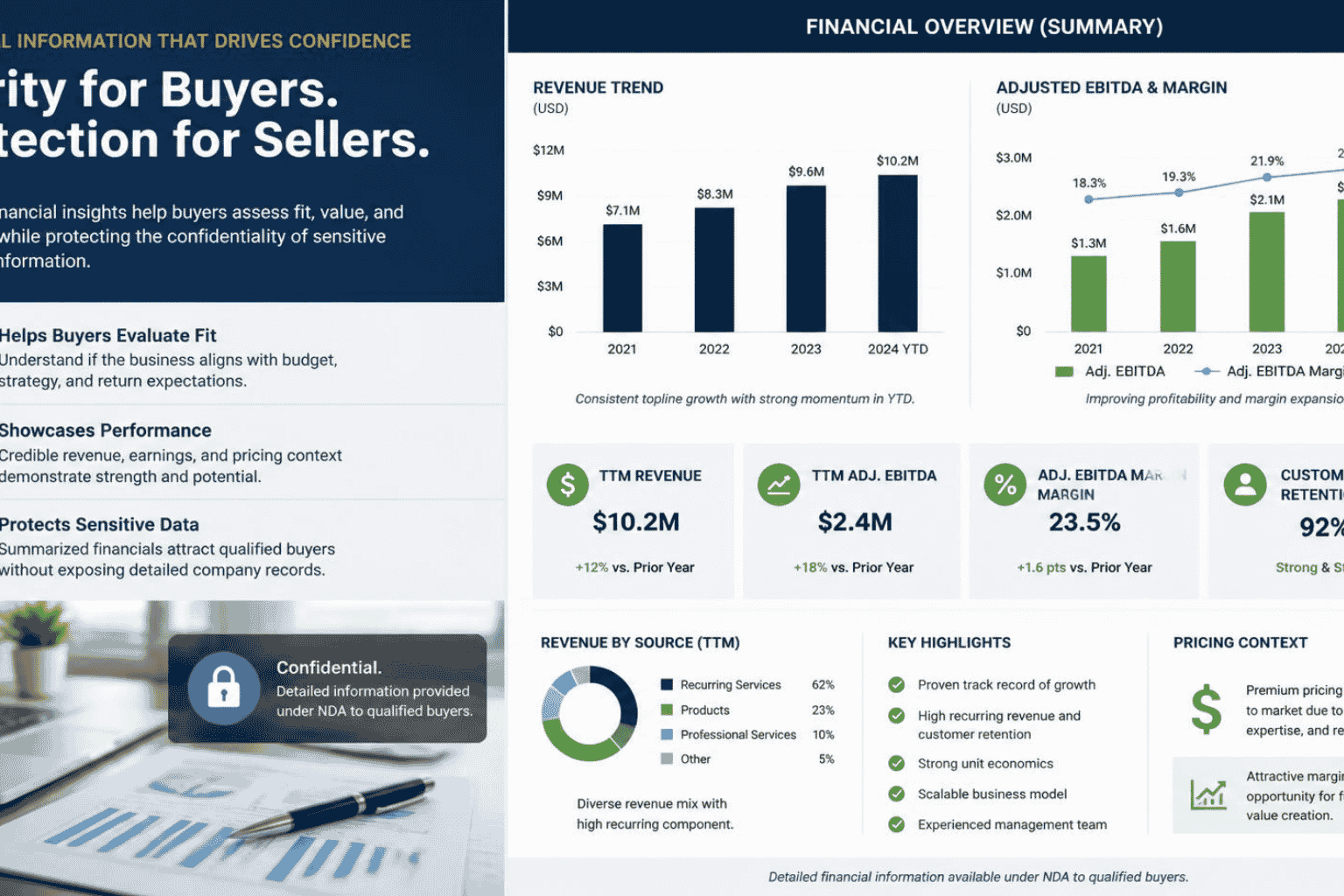
The exact process varies, but a qualified buyer may receive a confidential business profile or selected financial information before participating in a broker or seller discussion.
The first substantive meeting typically helps the buyer understand:
- How the company makes money
- Why the owner is considering a sale
- What the owner currently does
- How customers are acquired and retained
- What management and employees handle
- Where growth opportunities may exist
- What transition may be required
The meeting should provide meaningful context without turning immediately into unrestricted diligence.
1. Know the Company’s Financial Story
Buyers may already have high-level revenue and earnings information. The seller should be able to explain important changes in the numbers.
Common questions include:
- Why did revenue rise or fall?
- What caused margin changes?
- Are earnings seasonal?
- Which expenses are owner-related?
- Were there unusual one-time costs?
- Is the current year performing differently from prior years?
A seller who cannot explain the company’s own financial performance can create unnecessary buyer uncertainty.
2. Be Ready to Explain the Owner’s Actual Role
Buyers want to understand what must be replaced after closing.
An owner may spend time on sales, customer relationships, management, technical work, purchasing, finance, or strategic decisions.
The seller should explain honestly how much time is spent in the business and which responsibilities can transfer to managers or employees.
3. Prepare to Discuss Customer Concentration Without Oversharing
The buyer may ask how dependent the company is on major customers.
At an early meeting, customer names may not need to be disclosed. The seller can often discuss:
- Percentage of revenue from the largest customers
- Repeat or recurring business
- Contractual versus noncontractual relationships
- Average customer tenure
- Industries or customer types served
More sensitive information can be released later as diligence advances.
4. Explain the Management Team
A buyer will want to know who helps operate the company.
Useful information includes:
- Management roles
- Employee tenure
- Who handles daily operations
- Who manages customer relationships
- Which employees hold critical technical knowledge
- Whether key personnel are expected to remain
Management depth can significantly influence perceived transition risk.
5. Be Honest About Why You Are Selling
Buyers almost always ask this question.
Retirement, health, relocation, partnership changes, diversification, reduced workload, or pursuing another opportunity can all be understandable explanations.
What creates concern is an answer that changes repeatedly or appears inconsistent with other information.
6. Prepare Realistic Growth Opportunities
Buyers generally want to know where future growth could come from.
Strong opportunities are specific and supportable.
Examples may include:
- Unused production capacity
- Additional geographic markets
- Services customers already request
- Limited current marketing
- New distribution channels
- Cross-selling to an existing customer base
The seller should avoid presenting future growth as guaranteed.
7. Know What You Expect From the Transition
Some buyers may expect several weeks of seller training. Others may request months of consulting or continued employment.
The owner should begin thinking about:
- Desired transition length
- Hours available after closing
- Customer introductions
- Employee communication
- Technical training
- Whether additional consulting would require compensation
8. Do Not Turn the Meeting Into a Negotiation Too Early
A buyer may ask whether the seller would accept a lower price, finance part of the transaction, or agree to an earnout.
The seller does not need to negotiate every economic term during the first conversation.
The purpose is usually to determine whether both sides want to continue toward a more serious evaluation.
9. Evaluate the Buyer During the Meeting
The seller should also ask questions.
Useful areas include:
- Buyer’s acquisition experience
- Industry background
- Expected role after closing
- Financing strategy
- Transaction timing
- Reason for pursuing this specific business
The seller is trusting the buyer with increasingly sensitive information and should understand who may become the next owner of the company.
10. Agree on the Next Step
A productive meeting should end with clarity.
The next stage might involve:
- Additional financial information
- A management call
- A site visit
- Buyer financing confirmation
- Further questions
- An indication of interest
- A letter of intent
There should be no need to disclose the entire business merely because the first conversation went well.
Preparation Builds Buyer Confidence
Serious buyers understand that businesses are not perfect. They do expect the seller and broker to understand the company and provide consistent information.
Organized answers, credible financial explanations, realistic growth opportunities, and a clear transition story can help a qualified buyer move from general interest toward an offer.
Organize the financial story, management structure, owner role, growth opportunities, and confidentiality process before the first serious conversation.
Prepare Your Sale Process with EIN Business Brokers →
Frequently Asked Questions
What should I share with a buyer after an NDA is signed?
The appropriate information depends on the transaction stage, but sellers commonly begin with a confidential business profile and selected financial and operating information before releasing highly sensitive diligence materials.
Should I give customer names to a buyer during the first meeting?
Not necessarily. Sellers can often explain customer concentration, industries, repeat business, and relationship characteristics without identifying customers until a later stage.
What questions will a serious buyer ask a business seller?
Buyers commonly ask about financial performance, owner involvement, employees, customers, growth opportunities, reasons for sale, competitive position, and expected transition support.
Should the seller ask the buyer questions too?
Yes. The seller should understand the buyer’s experience, acquisition criteria, financing approach, timing, and intentions before progressively releasing more confidential information.
 The first qualified buyer meeting should build confidence while preserving confidentiality and keeping the transaction process controlled.