
Could Your Business Run Without You? Why Owner Dependence Matters Before a Sale
Could your business run without you?
For many owners, being essential to the company feels like a strength.
But when the time comes to sell, heavy owner dependence can create an important question for a prospective buyer:
What happens to the business when the current owner leaves?
Exit readiness is not only about revenue or profit. It can also involve how transferable the business is to new ownership.
What Is Owner Dependence?
Owner dependence exists when important parts of the business rely primarily on the owner rather than on the company itself.
That dependence may appear in areas such as:
- Customer relationships
- Sales
- Vendor relationships
- Employee management
- Pricing decisions
- Operational knowledge
- Financial approvals
- Key day-to-day decisions
In some businesses, nearly every important decision eventually reaches the owner.
That may work while the owner remains actively involved, but it can become a transferability issue during a sale.
Why Buyers May Care
A prospective buyer generally wants to understand whether the company can continue operating after ownership changes.
If customers buy primarily because of their personal relationship with the owner, or employees rely on the owner for every major decision, the buyer may see additional transition risk.
The question becomes less about whether the current owner can run the company successfully and more about whether someone else can take over that role.
Build a Business That Operates Through People
A capable management team or dependable employees can reduce the number of functions that depend entirely on the owner.
This does not mean the owner must become uninvolved.
It means important responsibilities can be delegated rather than concentrated in one person.
Areas to consider may include:
- Customer service
- Sales management
- Operations
- Purchasing
- Employee supervision
- Financial administration
Document Important Processes
Knowledge stored only in the owner’s head can be difficult to transfer.
Documenting repeatable processes can make the business easier to understand and operate.
Depending on the company, that might include procedures for:
- Opening and closing operations
- Serving customers
- Managing orders
- Handling suppliers
- Pricing work
- Hiring and onboarding employees
- Managing recurring administrative tasks
The objective is not to create paperwork for every small task.
It is to preserve important operating knowledge within the company rather than only with the owner.
Strengthen Customer Relationships Beyond the Owner
Customer concentration and owner dependence can overlap.
If major customers communicate only with the owner, a buyer may wonder whether those relationships will survive a transition.
Where appropriate, involving other employees in customer relationships can help make those relationships more connected to the company itself.
Distribute Decision-Making
A business can become difficult to scale or transfer when every decision requires owner approval.
Owners preparing for a future exit may want to examine which decisions genuinely require their involvement and which can be delegated through defined responsibilities and controls.
A company that continues functioning when the owner is absent for a day, a week or longer may be demonstrating greater operational independence.
Test the Business Before You Sell
One practical way to evaluate owner dependence is to observe what happens when the owner steps away.
Ask:
- Who handles customer issues?
- Who makes operating decisions?
- Who manages employees?
- Who controls key supplier relationships?
- Who knows how important processes work?
- What stops when the owner is unavailable?
The answers can reveal areas that may deserve attention before a sale process begins.
Reducing Owner Dependence Takes Time
This is usually not something that can be corrected immediately before listing a business for sale.
Building management capability, documenting processes, transferring relationships and creating operating discipline can take time.
That is one reason exit preparation can begin well before an owner plans to sell.
A Buyer Is Acquiring the Business, Not Just the Owner
The central exit-readiness question is simple:
Can the value created by the owner continue after the owner leaves?
A more transferable business may have:
- Capable people
- Documented processes
- Shared customer relationships
- Clear responsibilities
- Operational continuity
Those characteristics do not guarantee a particular valuation or sale outcome.
But they can help a prospective buyer understand how the business may function under new ownership.
EIN Business Brokers provides a starting point for owners preparing their companies for a potential future sale.
Business valuations, buyer interest, transaction structures, negotiations and closing outcomes vary by company and circumstances. Improving exit readiness does not guarantee a particular valuation or completed transaction.
Frequently Asked Questions
What does owner dependence mean when selling a business?
Owner dependence means important operations, customer relationships, decisions or knowledge rely heavily on the current owner, potentially making the company harder to transfer to new ownership.
Why might owner dependence concern a buyer?
A buyer may want confidence that customers, employees, operations and financial performance can continue after the current owner reduces involvement or leaves the company.
How can a business owner reduce owner dependence?
Potential steps include developing capable employees or management, documenting important processes, distributing responsibilities and building company-level relationships with customers and suppliers.
Does reducing owner dependence guarantee a higher business valuation?
No. Business valuation depends on many factors. Reduced owner dependence can strengthen transferability and exit readiness, but it does not guarantee a particular valuation or sale outcome.
Take the Next Step
Subscribe on YouTube:
https://www.youtube.com/@enterpriseindustrynetwork
Considering the value or future sale of your business?
Get Started with EIN Business Brokers:
https://www.einbb.com/get-started/
Exit. Acquire. Invest.
Explore Enterprise Industry Network
https://enterpriseindustrynetwork.com/
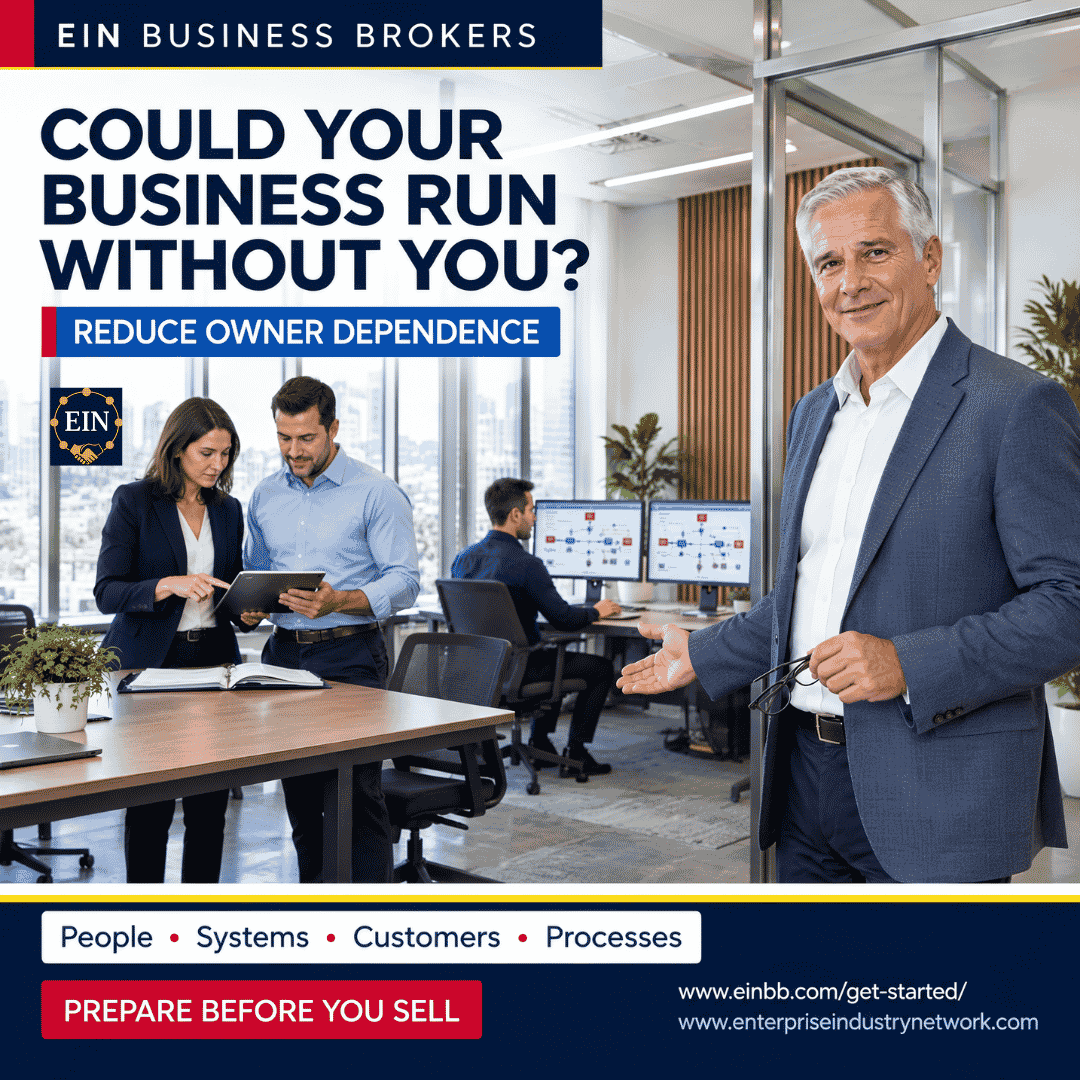 Reducing owner dependence can make a business easier for a prospective buyer to understand and transition to new ownership.