

What Can Lower Your Business Valuation Before a Sale? | EIN Business Brokers | Enterprise Industry Network | EINBB
If you are thinking about selling your business, understanding what can lower its valuation is just as important as knowing what can increase it. Strong revenue alone does not guarantee a strong sale value. Buyers also evaluate earnings quality, customer stability, management, owner dependence, financial records, growth, operational risk, and how easily the company can transfer to new ownership.
In this video, EIN Business Brokers (EINBB), part of the Enterprise Industry Network (EIN), explains the factors that can reduce business value and what sellers should review before putting a company on the market.
What Can Lower Your Business Valuation?
A business valuation can be affected when buyers identify risks that may reduce future earnings, increase transition difficulty, or create uncertainty after an acquisition.
- Declining or inconsistent earnings.
- Poor or disorganized financial records.
- Heavy customer concentration.
- Excessive dependence on the owner.
- Weak management depth.
- Limited recurring or predictable revenue.
- Key employee or supplier dependence.
- Unresolved legal, contractual, or operational risks.
- Weak growth prospects.
- Poor business transferability.
Can Declining Revenue or Profitability Lower Business Value?
Buyers typically examine historical financial performance to understand whether earnings are stable and sustainable. Declining revenue, shrinking margins, or inconsistent profitability may increase uncertainty about future performance.
- Declining sales can raise questions about market demand.
- Falling margins may indicate increasing costs or pricing pressure.
- Volatile earnings can make future cash flow harder to predict.
- Unexplained financial changes may require additional due diligence.
Sellers should understand the reasons behind significant financial changes and be prepared to support those explanations with reliable documentation.
How Do Messy Financial Records Affect Business Valuation?
Accurate and organized financial records are critical when buyers evaluate a company. If reported earnings are difficult to verify, buyers may place less confidence in the financial information presented.
- Incomplete financial statements.
- Inconsistent bookkeeping.
- Personal expenses mixed with business expenses.
- Unsupported EBITDA adjustments or add-backs.
- Differences between accounting records and tax returns.
- Missing supporting financial documentation.
Clean records can make it easier for buyers to understand normalized earnings, cash flow, and overall financial performance.
Why Customer Concentration Can Reduce Business Value
A business may appear riskier when a large percentage of revenue depends on one customer or a small group of customers. The loss of a major account after closing could materially affect future earnings.
- One customer represents a large percentage of revenue.
- Major accounts operate without long-term agreements.
- Important relationships depend personally on the seller.
- Customer retention is uncertain.
- Revenue diversification is limited.
Greater customer diversification can help reduce concentration risk and improve revenue stability from a buyer’s perspective.
Does Owner Dependence Lower Business Valuation?
It can. Buyers may be concerned when the company relies heavily on the owner for sales, operations, customers, employees, vendors, or critical decisions.
A buyer generally wants confidence that the business can continue operating after the seller reduces involvement or exits.
- Delegate key responsibilities.
- Document operating procedures.
- Develop managers and employees.
- Transfer important relationships to the company.
- Create repeatable systems independent of the owner.
Can Weak Management Affect the Value of a Business?
A company with little management depth may be more difficult to transition. If the seller is the primary decision-maker and no internal leaders are prepared to maintain operations, buyers may perceive greater acquisition risk.
- Undefined management responsibilities.
- Dependence on one key person.
- Limited leadership succession.
- Important knowledge concentrated with the owner.
- Weak reporting and accountability systems.
Why Recurring Revenue Matters to Buyers
Predictable revenue can help buyers estimate future financial performance. Businesses that rely primarily on irregular, one-time, or difficult-to-repeat sales may present greater uncertainty.
- Recurring contracts can improve revenue visibility.
- Repeat customers can demonstrate retention.
- Long-term agreements may provide additional predictability.
- A strong sales pipeline can support future revenue expectations.
The quality and durability of revenue can influence how buyers view both earnings and risk.
How Key Employee Dependence Can Affect Business Value
A business may carry additional risk if one employee controls critical relationships, technical knowledge, sales activity, or operational responsibilities.
Buyers may evaluate what could happen if that employee leaves during or after the ownership transition.
- Document important responsibilities and processes.
- Cross-train employees where appropriate.
- Reduce dependence on a single individual.
- Build stronger organizational knowledge.
- Develop management continuity.
Can Supplier Concentration Lower a Business Valuation?
A company that depends heavily on one supplier may face operational risk if that relationship changes, pricing increases, or supply becomes unavailable.
- Review critical supplier dependencies.
- Understand contract and pricing terms.
- Identify alternative suppliers where practical.
- Document key vendor relationships.
- Evaluate supply-chain vulnerabilities before a sale.
How Legal and Operational Risks Affect Business Value
Unresolved legal, compliance, contractual, or operational issues can create uncertainty during buyer due diligence and may affect negotiations.
- Pending disputes or claims.
- Expired or missing licenses.
- Problematic leases or contracts.
- Unclear ownership of intellectual property.
- Operational weaknesses.
- Unresolved employee or vendor matters.
Identifying these issues before going to market gives owners more time to address them before buyers begin their review.
Why Growth Prospects Matter in Business Valuation
Buyers often consider both historical earnings and the future potential of the company. A business with declining demand, limited expansion opportunities, or no clear growth path may be evaluated differently from a similar business with credible growth opportunities.
- Historical growth trends.
- Market demand.
- Sales pipeline.
- Expansion opportunities.
- New products or services.
- Scalability of operations.
How Poor Transferability Can Lower Business Value
A business must be able to transition from the current owner to a buyer. Poorly documented systems, owner-controlled relationships, weak management, and concentrated knowledge can make that transition more difficult.
Buyers may place greater confidence in businesses with:
- Documented operating procedures.
- Capable management.
- Transferable customer relationships.
- Organized financial records.
- Repeatable sales systems.
- Clear employee responsibilities.
Can You Improve Business Value Before Selling?
Business owners may be able to strengthen many of the factors buyers evaluate by preparing well before entering the market.
- Improve financial reporting.
- Strengthen revenue and profitability.
- Reduce customer concentration.
- Build recurring revenue.
- Reduce owner dependence.
- Develop management depth.
- Document business systems.
- Resolve avoidable legal and operational issues.
- Prepare for buyer due diligence early.
These improvements do not guarantee a specific valuation or sale price, but they can help reduce perceived risk and strengthen overall business sale readiness.
How EIN Business Brokers Helps Sellers Prepare for Valuation
EIN Business Brokers (EINBB), under the Enterprise Industry Network (EIN), works with business owners who are considering selling a company, evaluating business value, preparing for qualified buyers, and navigating the business sale process.
- Business valuation and market positioning.
- Seller readiness and exit planning.
- Identification of potential valuation risks.
- Confidential buyer outreach.
- Buyer qualification.
- Negotiation and transaction coordination.
- Support throughout the business sale process.
If you are thinking about selling your business, identifying the factors that could reduce value before going to market can give you more time to strengthen your company and prepare for buyer scrutiny.
Could Hidden Risks Be Lowering Your Business Value?
If you are considering selling your business, identify valuation risks before buyers do. Understand what your business may be worth and begin preparing your exit confidentially with EIN Business Brokers.
Frequently Asked Questions
What can lower the valuation of my business?
Factors that may lower business valuation include declining earnings, poor financial records, customer concentration, owner dependence, weak management, limited recurring revenue, key employee dependence, operational risks, and weak growth prospects.
Does customer concentration lower business value?
It can. When a large percentage of revenue depends on a small number of customers, buyers may perceive greater risk because losing one major account could materially affect future earnings.
Can owner dependence affect what my business is worth?
Yes. Heavy dependence on the owner can increase transition risk if sales, operations, customer relationships, or important decisions cannot continue easily after ownership changes.
Do messy financial records reduce business valuation?
Poor or difficult-to-verify financial records can reduce buyer confidence and make normalized earnings, cash flow, and profitability harder to evaluate during valuation and due diligence.
Can declining profits affect the sale price of a business?
Declining profitability may affect buyer expectations because buyers consider whether historical earnings are sustainable and what financial performance may look like after the acquisition.
How can I improve my business value before selling?
Owners can work to improve financial performance, clean up financial records, diversify customers, build recurring revenue, strengthen management, reduce owner dependence, document operations, and address avoidable risks before going to market.
How can EIN Business Brokers help me understand what my business may be worth?
EIN Business Brokers can assist with business valuation, market positioning, seller readiness, confidential buyer outreach, buyer qualification, negotiation, and transaction coordination.
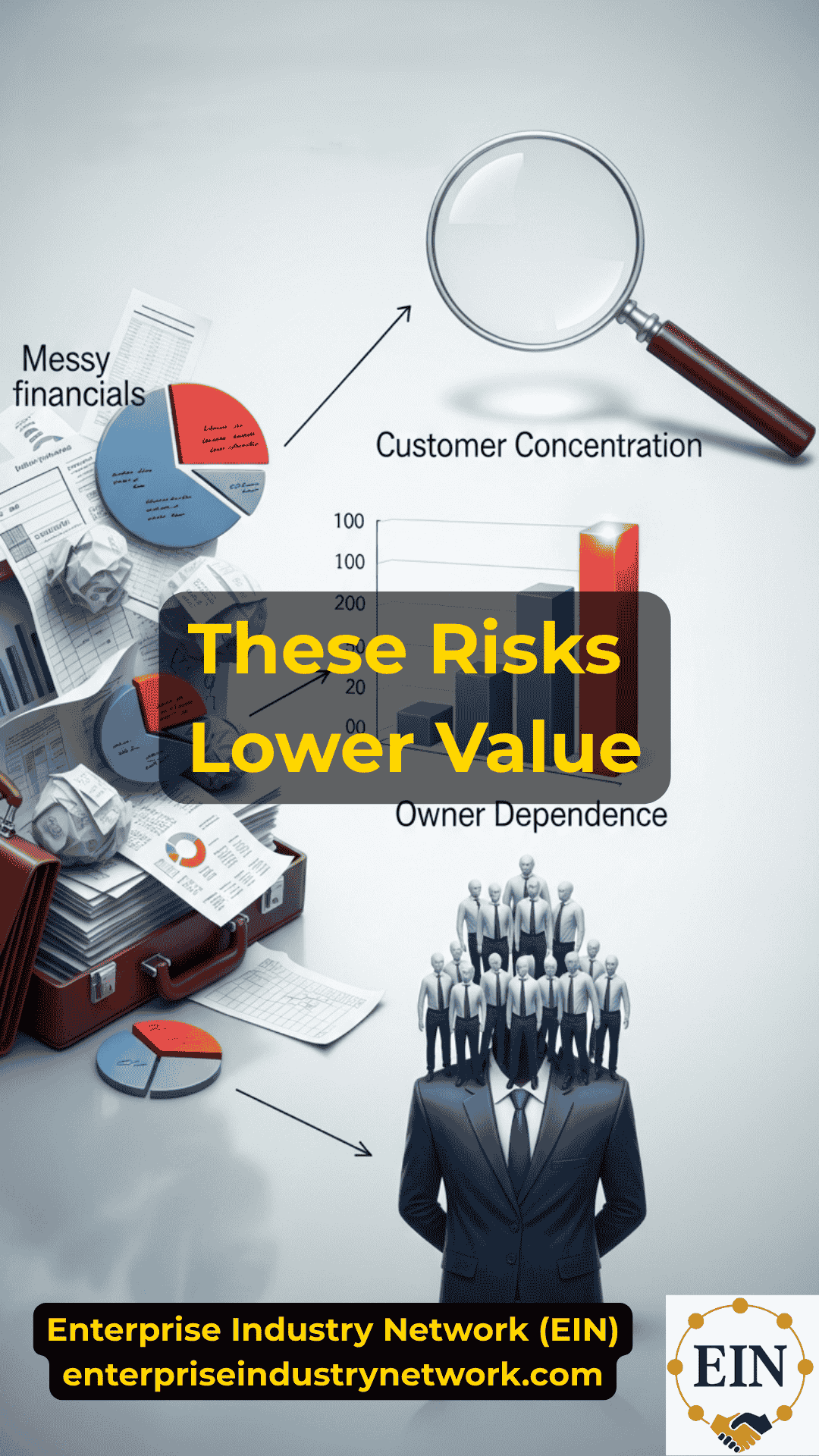 Declining earnings, customer concentration, owner dependence, weak management, poor financial records, and operational risks can negatively affect how buyers value a business.