

Revenue, Cash Flow, Asking Price: What Financial Information Should a Business-for-Sale Listing Show?
Financial information is one of the first things serious acquisition buyers look for in a business-for-sale listing. Yet sellers often struggle with how much should be made public.
Provide too little and buyers may skip the opportunity because they cannot determine financial fit. Provide too much and confidential information may be exposed before the buyer has been qualified.
The strongest listing gives buyers enough financial context to decide whether deeper evaluation makes sense.
Why Do Buyers Want Financial Information in the Listing?
Most buyers search within defined financial parameters.
They may have limits around:
- Purchase price
- Buyer equity
- Required cash flow
- Revenue scale
- Financing capacity
If none of this information is available, the buyer cannot determine whether the opportunity belongs in the acquisition search.
Should a Listing Show Annual Revenue?
Revenue is one of the easiest financial measures for buyers to understand and can help establish company scale.
However, revenue by itself does not explain profitability.
A $5 million business earning very little can present a very different acquisition opportunity from a $2 million business producing strong, sustainable cash flow.
Where appropriate, revenue should be presented with additional economic context.
What Does “Cash Flow” Mean in a Business Listing?
The term can be confusing because marketplaces and sellers may use it differently.
Depending on the transaction, buyers may encounter seller’s discretionary earnings, EBITDA, adjusted EBITDA, operating cash flow, or another earnings measure.
The listing should use terminology accurately and consistently so the buyer understands what the reported number represents.
Unsupported adjustments can create problems later during valuation, financing, and diligence.
Should a Business Listing Show the Asking Price?
Publishing an asking price can help buyers self-qualify and may improve search relevance where marketplaces allow price filtering.
Some transactions, however, may use confidential pricing because buyer type, strategic value, transaction structure, or competitive bidding could influence valuation.
The pricing strategy should reflect the business and expected buyer market.
Asking Price and Buyer Cash Requirement Are Not the Same
Buyers should not assume the asking price represents the amount of cash they must personally provide at closing.
A transaction may ultimately involve combinations of:
- Buyer equity
- Acquisition financing
- Seller financing
- Investor capital
- Other negotiated consideration
The listing does not need to predict the final capital structure, but sellers should understand whether the asking price appears financeable for likely buyers.
Should the Listing Show Financial Trends?
A single year can be misleading.
A company may have experienced temporary disruption, unusual growth, one-time revenue, or changing margins.
Depending on the marketplace and confidentiality strategy, providing historical context such as “three consecutive years of revenue growth” may help buyers understand the opportunity without publishing full financial statements.
Detailed year-by-year information can be provided later in the confidential process.
Should Seller Add-Backs Appear in the Listing?
Owner-related or unusual expenses may be relevant to normalized earnings.
Examples can include certain owner compensation, personal expenses properly recorded through the business, or one-time costs that are not expected under new ownership.
Any adjustments should be supportable.
A listing that relies on aggressive or unexplained add-backs may attract interest initially but create credibility problems during diligence.
What Financial Information Should Usually Stay Confidential?
Public listing information does not need to include every financial record.
Sensitive information may include:
- Tax returns
- Bank statements
- Customer-level revenue
- Payroll details
- Supplier pricing
- Debt account information
- Detailed receivables
- Internal forecasts
These materials can be shared later after buyer qualification and appropriate confidentiality protection.
Use Financial Ranges When Exact Disclosure Is Unnecessary
Depending on the marketplace and transaction, a seller may use ranges rather than exact figures at the earliest stage.
A range can help the buyer determine general fit while preserving additional confidentiality.
The range should still be accurate enough to avoid attracting buyers who would immediately become unsuitable once exact financials are released.
Financial Numbers Should Match the Confidential Package
One of the fastest ways to lose buyer confidence is for the public listing to present financial information that does not match later materials.
Before publication, confirm that revenue, earnings, asking price, financial periods, and terminology are consistent across:
- Marketplace listing
- Confidential profile
- Broker materials
- Seller discussions
- Supporting statements
Clear Financial Information Improves Lead Quality
The goal is not to generate inquiries from everyone.
A financially transparent listing helps unsuitable buyers self-select out while attracting buyers whose capital and acquisition criteria are closer to the opportunity.
This can reduce wasted seller time and improve the quality of confidential conversations.
Think of the Listing as the First Financial Filter
A strong listing should allow a buyer to determine whether the business is broadly relevant without providing enough information to complete diligence publicly.
Professional listing preparation combines appropriate revenue, earnings, price, operating context, confidentiality, and buyer qualification to create a more effective acquisition funnel.
Give qualified buyers enough financial context to determine fit while protecting sensitive information for the confidential stage.
Prepare Your Business Listing with EIN Business Listings →
Frequently Asked Questions
Should I show revenue in a business-for-sale listing?
Revenue can help buyers understand company scale, but it is more useful when paired with credible earnings or cash-flow context appropriate to the transaction.
Should I publish the exact cash flow of my business?
That depends on the listing strategy and marketplace. If an earnings figure is published, the measure should be clearly defined and supportable by later financial documentation.
Should tax returns be included in a public listing?
No. Detailed tax returns and similar confidential financial records are generally more appropriate for qualified buyers during the confidential diligence process.
Does showing financial information improve buyer leads?
Clear, credible financial context can help buyers self-qualify and may reduce inquiries from prospects whose acquisition budget or financial criteria do not fit the opportunity.
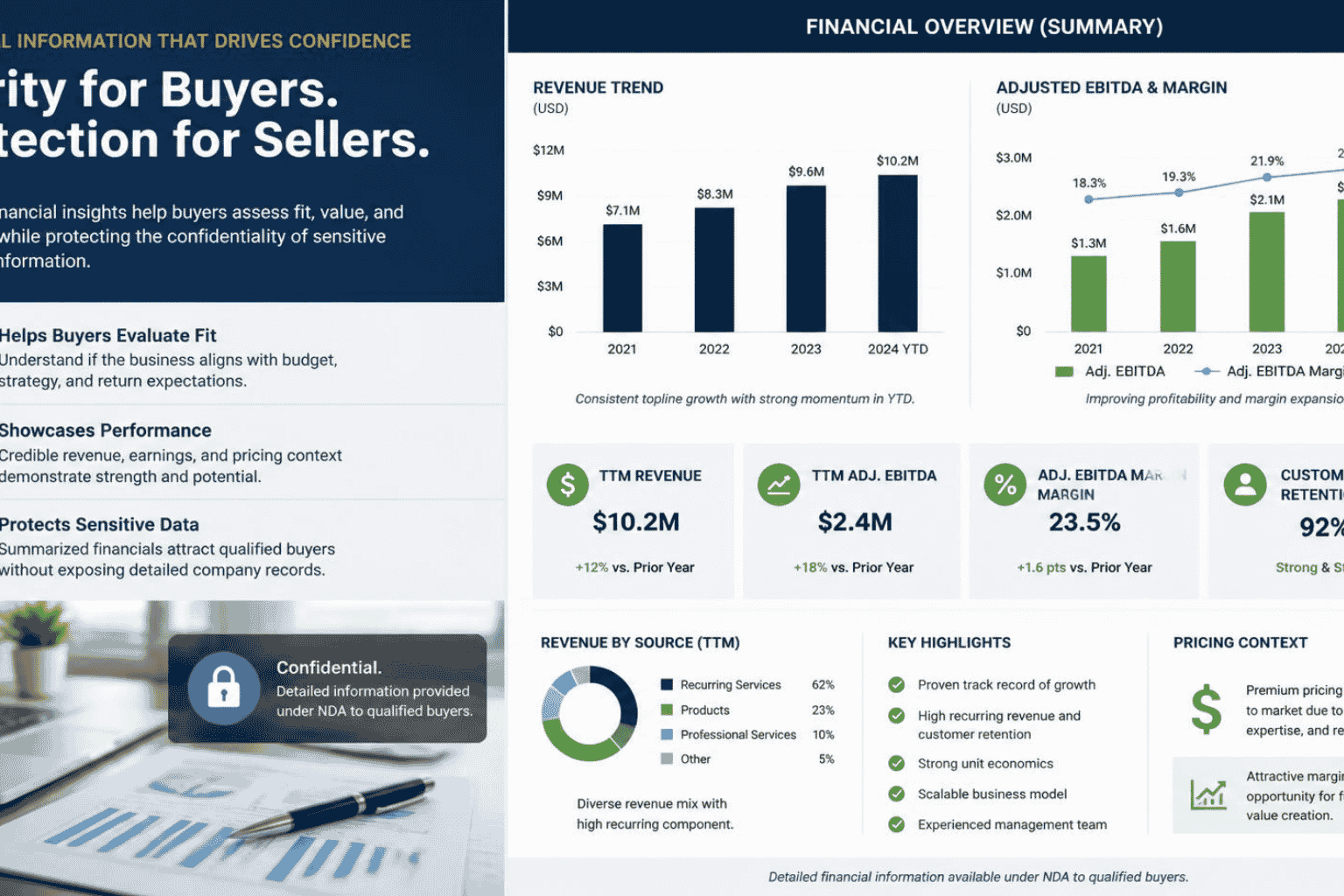 Revenue, earnings, and asking-price information can help acquisition buyers determine fit before entering the confidential sale process.