
Raising Capital? Build the Process Before You Start Investor Outreach
Raising capital?
Investor outreach should not begin simply by collecting names and sending a pitch deck everywhere.
A more deliberate capital-raise process starts with preparing the opportunity, defining what the company is seeking and identifying the types of investors that may fit before outreach begins.
1. Clarify the Capital Story
A prospective investor should be able to understand what the company does, what problem it addresses, how the business is progressing and why additional capital is being sought.
The story should connect the business opportunity with the capital requirement.
Founders should be prepared to explain:
- What the company does
- Who the customer is
- What traction has been achieved
- How much capital is being raised
- How the capital is expected to be used
- Why the timing makes sense
2. Prepare the Core Materials
Investor conversations may move quickly when there is genuine interest.
That makes it useful to have the core materials organized before outreach begins.
Depending on the company and transaction, those materials may include a pitch deck, financial information, ownership information, business metrics, use-of-funds details and other company-specific information.
3. Define the Capital Requirement
A broad statement that the company is “looking for investors” is not the same as a defined capital strategy.
Founders should understand how much capital is being sought, what the capital is intended to accomplish and what stage of growth or business objective the raise is designed to support.
The capital requirement can influence which investors are appropriate to approach.
4. Identify the Right Investor Profile
Not every investor considers every opportunity.
Potential fit may depend on company stage, sector, geography, investment size, business model and transaction structure.
Targeting investors whose mandate may align with the company can make outreach more focused than sending the same materials to a broad, unrelated audience.
5. Control the Outreach Process
Investor outreach should be organized.
Founders may benefit from tracking who has been contacted, when information was shared, what response was received and what follow-up is appropriate.
A controlled process can also help reduce duplicate outreach and inconsistent communication.
6. Be Ready for Deeper Review
Interest in a pitch does not mean an investment decision has been made.
If an investor decides to explore the opportunity further, additional questions, meetings, documentation and due diligence may follow.
Founders should be prepared to support the claims made in the pitch with appropriate business information.
7. Expect the Process to Be Selective
Investor outreach can result in different responses.
Some investors may decline because the opportunity is outside their mandate. Others may want additional information. Some may decide to continue evaluating the company.
A decline does not necessarily mean the business itself is weak; it may simply mean that particular investor is not a fit.
Capital Raising Is a Process — Not a Single Pitch
A pitch deck is important, but it is only one part of raising capital.
The broader process includes preparing the company, defining the ask, identifying potential investor fit, managing outreach, responding to questions and supporting deeper review when appropriate.
EIN Venture Capital provides a starting point for businesses preparing for capital discussions and exploring potential investor fit.
Investor mandates, interest, due diligence, terms and investment decisions vary by investor and opportunity. An inquiry, review, meeting or introduction does not guarantee investment or funding.
Frequently Asked Questions
What should a company prepare before contacting investors?
A company may benefit from preparing a clear business story, capital requirement, use of funds, pitch materials, financial information and other supporting information relevant to the opportunity.
Should a company contact as many investors as possible?
Not necessarily. A more targeted approach can focus on investors whose stage, sector, geography, investment size and mandate may align with the opportunity.
Does investor interest mean the company will receive capital?
No. Initial interest may lead to additional conversations or due diligence, but final investment decisions depend on the investor and the opportunity.
Is a pitch deck enough to raise venture capital?
A pitch deck can be an important communication tool, but investors may also require additional business, financial, ownership, market and transaction information before making an investment decision.
Take the Next Step
Subscribe on YouTube:
https://www.youtube.com/@enterpriseindustrynetwork
Looking to raise capital for your business?
Explore Capital Solutions with EIN Venture Capital:
https://www.einvc.com/get-capital/
Exit. Acquire. Invest.
Explore Enterprise Industry Network
https://enterpriseindustrynetwork.com/
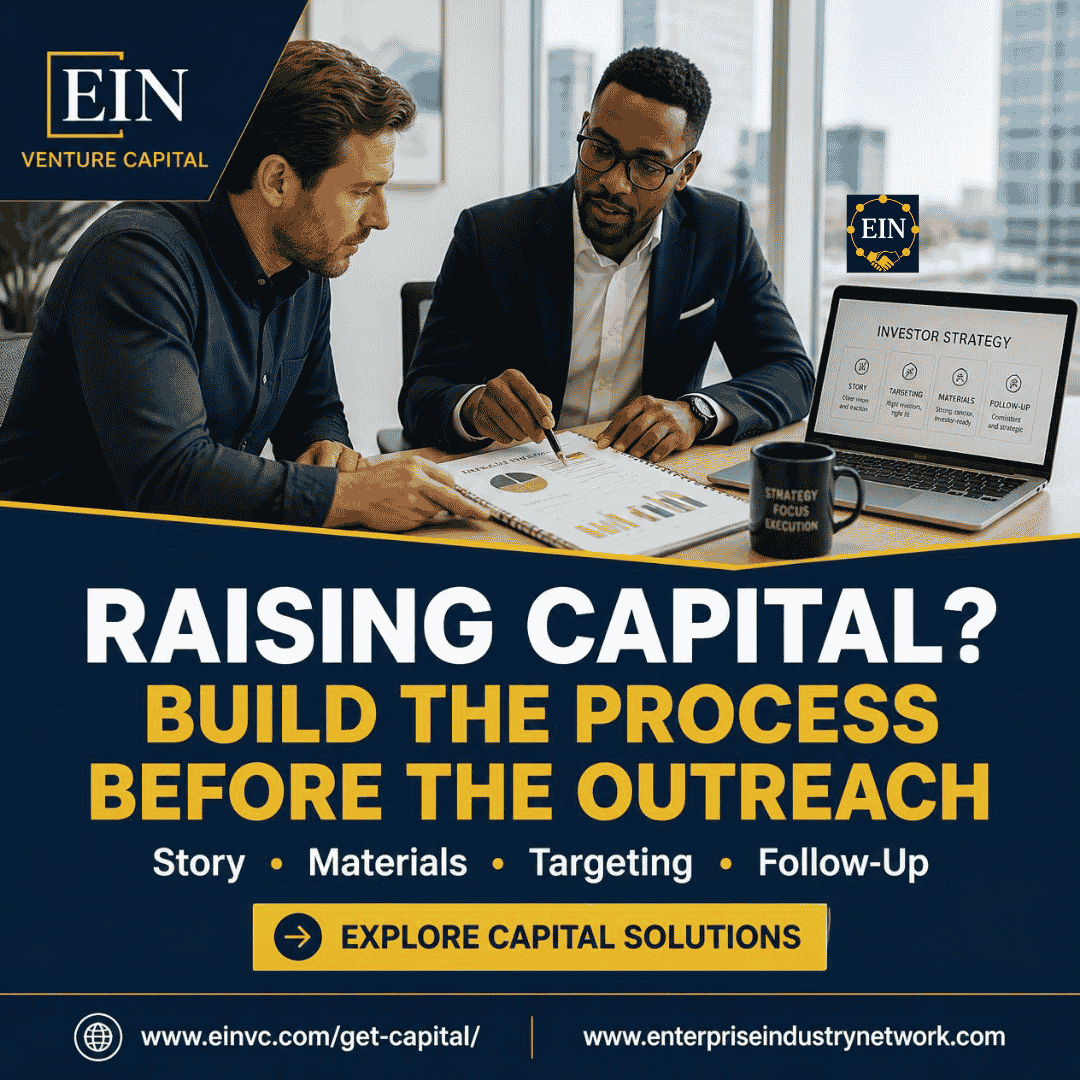 A disciplined capital raise starts with preparation and investor targeting before outreach begins.