
Gift Cards, Customer Deposits, Returns, and Prepaid Orders in a Business Sale: Who Is Responsible After Closing?
A business sold during or shortly after the holiday season may have collected cash for obligations that have not yet been fulfilled.
Examples can include:
- Gift cards
- Customer deposits
- Prepaid orders
- Returns
- Refund obligations
- Loyalty rewards
- Service packages
These items can appear small individually but become significant when thousands of holiday transactions are involved.
Buyers and sellers should determine explicitly who is responsible after closing.
The appropriate legal and accounting treatment depends on the transaction structure, contracts, applicable law, and specific facts. Qualified transaction counsel and accounting professionals should review the deal.
Why Holiday Transactions Create Closing Issues
Consider a business that sells $100,000 of gift cards in December and closes a sale of the company in January.
The seller may have already received the cash.
The buyer may later provide the products or services when customers redeem those cards.
Unless the purchase agreement addresses the economic responsibility, the parties can disagree about who should bear the cost.
1. Outstanding Gift Cards
Gift cards can create future redemption obligations.
The parties should understand:
- Total outstanding balance
- Historical redemption rate
- Expiration treatment where legally permitted
- Applicable unclaimed-property rules
- Who receives the economic benefit and burden
2. Customer Deposits
A business may collect deposits for work that will be completed after closing.
Examples include:
- Events
- Construction projects
- Custom products
- Professional services
- Equipment orders
If the seller received the deposit but the buyer must complete the work, the purchase economics should account for that obligation.
3. Prepaid Orders
Holiday businesses may receive payment before:
- Shipping
- Pickup
- Installation
- Service delivery
The closing process should identify orders that remain unfulfilled.
4. Returns and Refunds
A buyer taking ownership in January may receive returns for products sold by the seller in December.
The agreement should address:
- Return window
- Refund responsibility
- Inventory returned
- Chargebacks
- Payment-processing adjustments
5. Loyalty Points and Rewards
Customer loyalty programs may create economic expectations even when accounting treatment differs from traditional liabilities.
Buyers should understand:
- Outstanding points
- Historical redemption
- Program terms
- Technology supporting the program
6. Memberships and Subscriptions
Customers may have prepaid for:
- Annual memberships
- Service plans
- Subscription periods
- Maintenance programs
Determine how much future service remains after closing.
7. Warranty Obligations
Products sold before closing may require warranty service afterward.
The purchase agreement should clarify responsibility for historical sales and related claims.
8. Merchant Chargebacks
Credit-card disputes can arise weeks or months after the original transaction.
Buyers and sellers should understand:
- Who controls merchant accounts
- Who bears pre-closing chargebacks
- Whether reserves are held
9. Customer Credits
A company may have issued credits that customers can use against future purchases.
Those credits should be identified and considered in the transaction.
10. Working Capital Can Capture Some—but Not All—Issues
Some customer obligations may be reflected in working-capital accounts.
Others may require specific treatment.
The parties should not assume that a generic working-capital adjustment resolves every prepaid customer obligation automatically.
11. Asset Sale vs. Equity Sale Can Matter
Transaction structure can influence how liabilities are addressed.
In an asset sale, the purchase agreement typically identifies which liabilities the buyer assumes.
In an equity transaction, the entity itself generally continues to hold its existing obligations, subject to negotiated protections and applicable law.
Transaction counsel should evaluate the specific structure.
12. Build a Closing Schedule
Before closing, prepare schedules showing outstanding:
- Gift cards
- Deposits
- Prepaid orders
- Returns
- Credits
- Membership obligations
This creates a clearer basis for negotiation.
13. Define the Economic Adjustment
The parties may address these obligations through mechanisms such as:
- Purchase-price adjustment
- Working-capital treatment
- Assumed-liability provisions
- Escrow
- Specific reimbursement arrangements
The appropriate structure depends on the transaction.
14. Consider the Customer Experience
Customers generally do not care which owner received the original payment.
They expect the business to honor legitimate commitments.
Transition planning should protect customer relationships while allocating the economic burden appropriately between buyer and seller.
15. Do Not Leave Holiday Liabilities Until Closing Day
The weeks around year-end can produce unusually high volumes of gift cards, returns, deposits, and prepaid orders.
Buyers and sellers should begin identifying these obligations during diligence rather than discovering them after the business changes hands.
Define Responsibility Before Ownership Changes
A seemingly small customer obligation can become a meaningful financial issue when multiplied across thousands of transactions.
Transaction counsel can help buyers and sellers identify customer-related liabilities, coordinate them with working capital and purchase-price mechanics, and document responsibility clearly in the definitive agreement.
Identify the obligations and define who bears the economic responsibility before the transaction closes.
Consult EIN Legal Counsel →
Frequently Asked Questions
Who is responsible for gift cards after a business is sold?
The answer depends on the transaction structure, purchase agreement, applicable law, and how the parties allocate liabilities. Buyers and sellers should address outstanding gift-card obligations specifically rather than assume the result.
What happens to customer deposits when a business changes ownership?
The transaction should identify outstanding deposits and determine who must complete the related work and how the economic value of deposits already collected is allocated between buyer and seller.
Should returns from pre-closing sales be covered in the purchase agreement?
Yes. The agreement can address responsibility for refunds, chargebacks, returned inventory, customer credits, and other obligations arising from sales completed before closing.
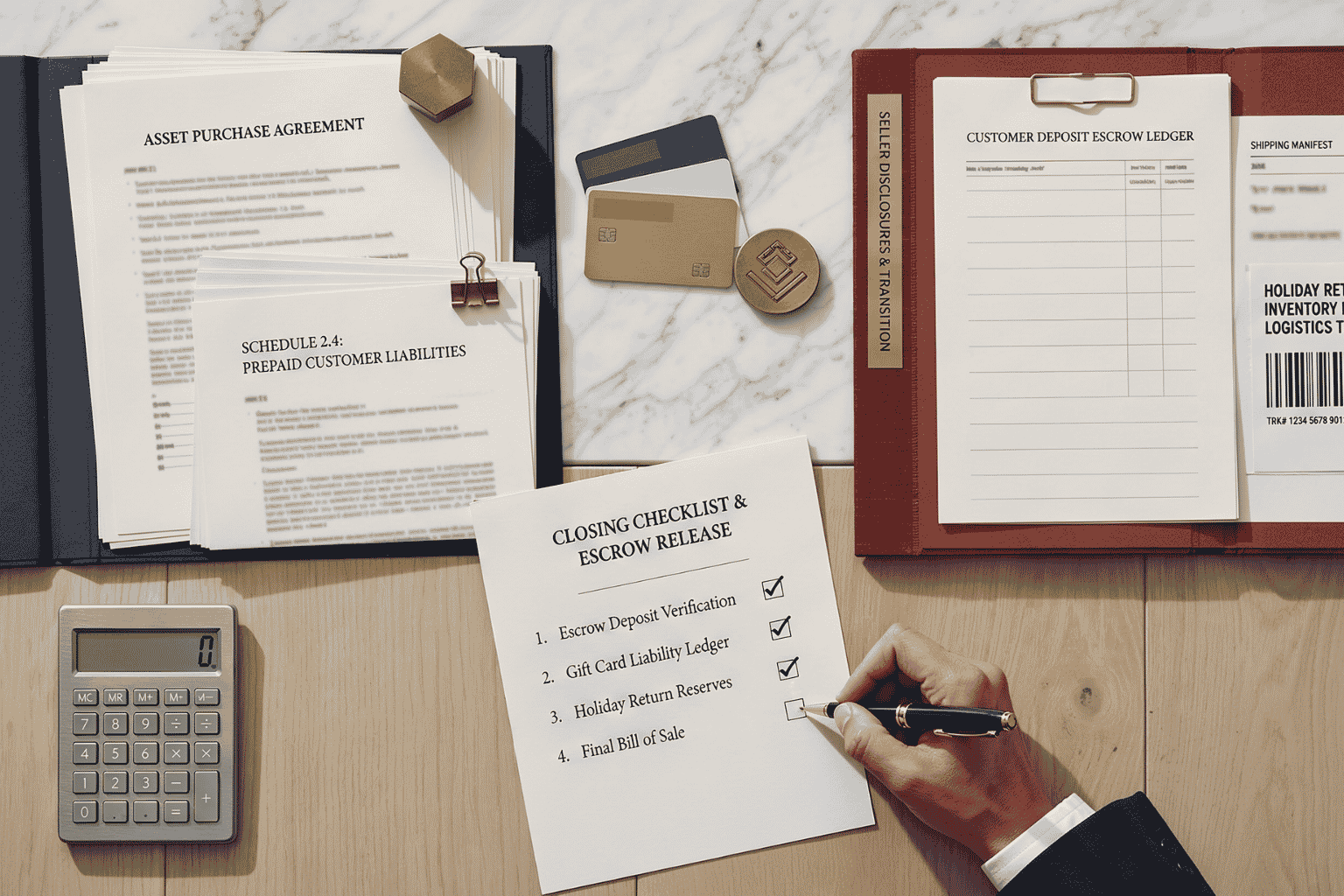 Gift cards, deposits, prepaid orders, returns, and customer credits should be identified and allocated clearly before a business changes ownership.