
Equipment Financing With EIN: Can a 1-Year Business With 600 Credit Qualify?
Equipment financing is one of the clearest business-funding searches because the borrower usually knows exactly what needs to be purchased and how much it costs. The harder question is whether the business profile behind that equipment request is ready for financing.
Owners frequently search for equipment financing with an EIN because they want the company itself to support the purchase. The EIN is important business information, but it does not automatically replace credit, revenue, operating history or repayment analysis.
If you already have an equipment quotation and your business has approximately a year of operating history, complete the EIN Business Funding Quick Lead Pre-Qualification using the actual equipment price, business revenue and current credit profile.
Can a Business With Around 600 Credit Get Equipment Financing?
Potentially. There is no single universal credit threshold for every equipment-financing provider.
A score around 600 may narrow some options, but the provider may also evaluate the type of equipment, time in business, annual revenue, business cash flow, bank activity and existing obligations.
The correct question is therefore not whether 600 credit automatically qualifies. It is whether the complete transaction is strong enough to warrant review.
Why One Year in Business Can Matter
A company with approximately one year of operations can provide more evidence than a newly formed business. The provider may be able to review actual revenue, bank deposits, operating expenses and business history.
That does not mean one year is a universal minimum for equipment financing. Different providers can have different requirements.
Why the Equipment Quote Matters
Equipment financing should begin with a real asset rather than a general request for money.
Have the vendor quotation, equipment description, purchase price and expected delivery timeline ready.
If the purchase includes multiple units, list them clearly.
What if the Equipment Is Used Rather Than New?
Used equipment can still represent a productive business asset, but the provider may want to understand the age, condition, value and expected useful life of the equipment.
The financing structure should make sense relative to how long the asset is expected to remain economically useful.
Revenue Can Strengthen the Request
A lender wants to understand how the company will repay the financing.
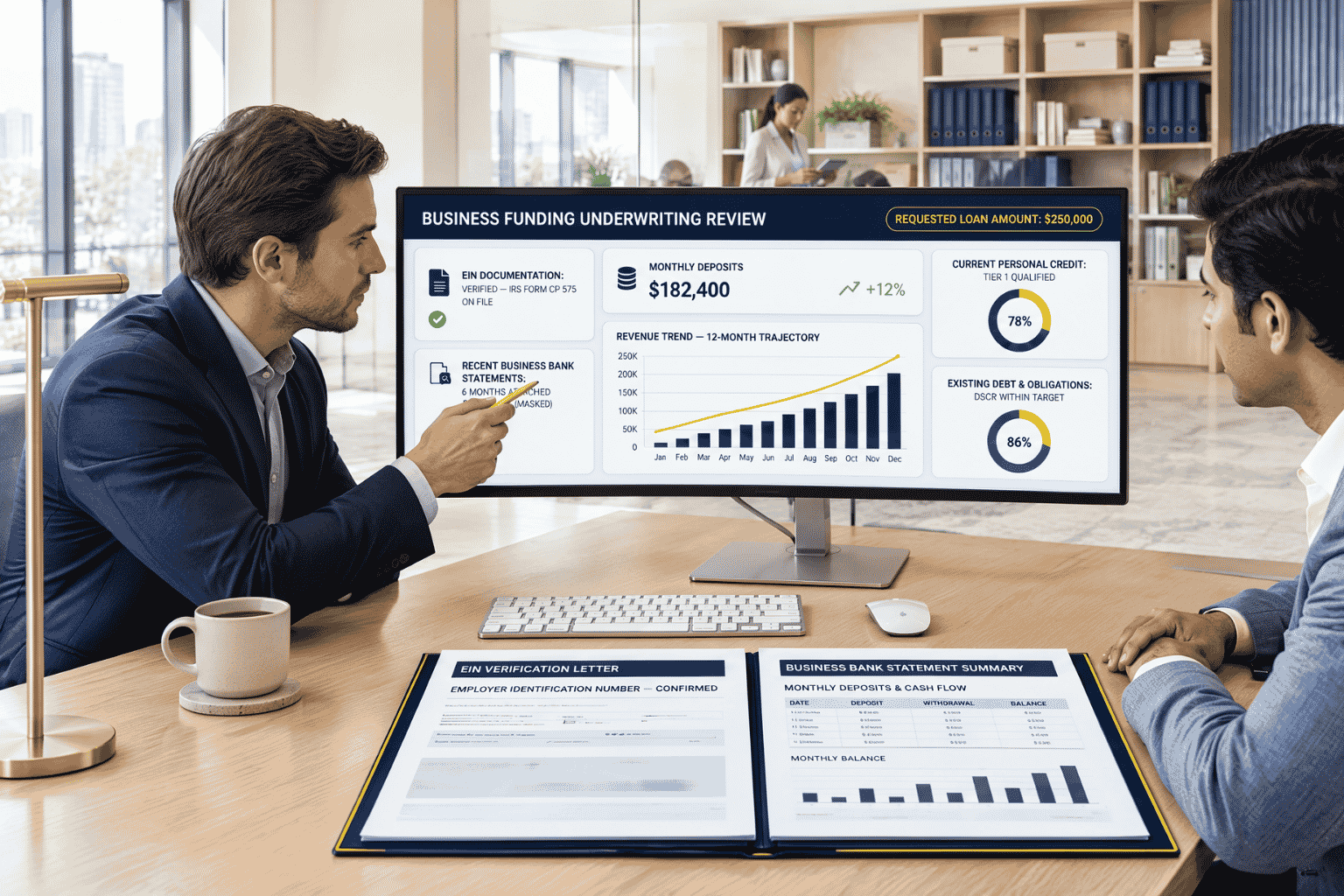
Strong annual revenue can help demonstrate the scale of the business, while recent deposits can show whether the company is currently generating consistent operating activity.
Revenue alone does not guarantee approval because existing expenses and debt can materially affect repayment capacity.
What if the Business Has $100K+ in Annual Revenue?
Crossing $100,000 in annual revenue can make the broader funding profile more established. The EIN Business Funding guidance uses $100,000+ annual revenue as a common benchmark for term-loan profiles, together with one or more years in business, approximately 600 to 680+ credit and positive cash flow.
Equipment financing has its own underwriting structure, but those numbers help explain why operating history and revenue can strengthen a broader business-funding request.
Why Existing Debt Matters
If the business already finances trucks, machinery, credit lines or other assets, another equipment payment will be added to those obligations.
Prepare the lender name, current balance, applicable limit and open date for existing business debt.
Does EIN Financing Mean No Personal Guarantee?
Not necessarily. “Financing with EIN” describes the business context of the application; it should not be interpreted as a promise that personal credit or a personal guarantee will never be required.
Requirements depend on the provider and financing structure.
Separate Equipment From Installation
The equipment purchase may also require delivery, installation, electrical work, tooling, software, training or other implementation expenses.
Identify those costs separately so the funding request accurately describes the project.
Do Not Hide Working Capital Inside the Equipment Purchase
A new asset can create additional operating expenses. A manufacturer may need more raw materials. A contractor may need additional payroll. A delivery company may need fuel and insurance.
Those expenses should be identified as working capital rather than automatically added to the equipment cost.
What Should You Prepare Before Funding Review?
- Equipment quotation
- Purchase price
- New or used equipment details
- Business formation date
- EIN
- Annual business revenue
- Recent business deposits
- Current personal credit profile
- Existing business debt
- Installation or implementation costs
Why This Search Can Produce Better Funding Decisions
A business owner searching for equipment financing is already much closer to a real transaction than someone simply researching generic capital.
The best next step is to connect the actual equipment purchase with the company’s real borrower profile rather than assuming an EIN or a particular credit score guarantees the result.
FAQs
Can I get equipment financing with an EIN and around 600 credit?
Potentially. Equipment-financing requirements vary, and providers may also evaluate business history, revenue, cash flow, bank activity, existing debt and the equipment itself.
Does one year in business improve equipment-financing options?
It can provide more operating history and financial information for a provider to review, although minimum time-in-business requirements vary.
Does equipment financing with an EIN mean personal credit will not be checked?
No. An EIN identifies the business, but some providers may still review personal credit or require additional owner support depending on the financing structure.
 An EIN identifies the business, while equipment financing can also depend on credit, operating history, revenue and the asset being purchased.