Collaborative Robot Financing: Equipment Loan or Term Loan for Cobots and Automation?
Collaborative robots, or cobots, can help smaller manufacturers automate repetitive production tasks without building an entirely separate high-volume robotic production line. But the financing requirement is often larger than the price of the robotic arm itself.
Tooling, vision systems, safety equipment, software, integration, electrical work and employee training can materially increase the total project cost.
If your company already has a cobot or automation quotation and is ready to move from planning to purchase, complete the EIN Business Funding Quick Lead Pre-Qualification with the project amount and current business profile.
Start With the Physical Cobot Equipment
Identify the tangible assets being purchased and the price of each major component.
- Collaborative robotic arm
- End-of-arm tooling
- Grippers
- Vision systems
- Conveyors or material-handling equipment
- Safety equipment
- Controllers and related hardware
A clear equipment list makes it easier to understand which part of the project may fit asset-based equipment financing.
Separate Integration From the Hardware
The robot may require engineering, programming, integration with existing machinery, electrical work and changes to the production process.
Those services may not be treated exactly the same way as the physical equipment itself.
List them separately rather than assuming the entire automation project is one equipment purchase.
Can Equipment Financing Fit a Cobot?
Potentially. Equipment financing is one of the business-funding categories used for qualifying tangible business assets.
Whether a specific cobot system qualifies depends on the provider, asset, business profile and complete transaction.
When May a Term Loan Be Worth Comparing?
A term loan may be relevant when the automation project extends well beyond the physical robot and includes substantial implementation, software or other defined project expenses.
The EIN Business Funding guidance identifies approximately 600 to 680+ personal credit, one or more years in business, $100,000+ annual revenue and positive cash flow as common term-loan benchmarks.
Could SBA 504 Be Relevant to a Larger Automation Project?
For qualifying long-term fixed assets and larger equipment investments, SBA 504 may also be worth evaluating.
The program is designed primarily around qualifying commercial real estate, large equipment and other long-term fixed assets. Actual eligibility and financing structure depend on program and lender requirements.
Do Not Ignore Software Costs
Automation increasingly combines physical machinery with software. Programming, licenses, machine vision, data integration or control systems can be necessary for the equipment to perform its intended function.
Identify those costs separately so the financing request accurately describes what the business is purchasing.
What About Employee Training?
A cobot still needs operators, technicians and managers who understand the new workflow.
Training is part of implementation but is different from the underlying physical asset. Include it in the total project budget while separating it from the equipment purchase.
Calculate the Working-Capital Impact
Automation can create a temporary cash-flow requirement even when the investment is expected to improve long-term efficiency.
The company may need to run old and new processes simultaneously, reduce production temporarily during installation or build additional inventory before the changeover.
If the project also requires operating capital, identify that need separately.
What Should a Manufacturer Prepare?
- Cobot equipment quotation
- Tooling costs
- Integration and engineering expenses
- Software costs
- Installation expenses
- Training budget
- Total requested financing amount
- Business formation date
- Annual revenue
- Current credit profile
- Existing business debt
How Should the Return on Automation Be Viewed?
The business should understand why it is making the investment. Potential benefits may include improved capacity, more consistent production, reduced bottlenecks or redeployment of employees to higher-value work.
However, projected savings should not be treated as guaranteed cash flow. Financing should still be evaluated against the company’s current ability to support repayment.
One Robot and a Full Automation Program Are Different Funding Requests
A single cobot with straightforward tooling may fit a relatively simple equipment-financing request.
A multi-station automation program involving robotics, conveyors, software, integration and facility changes may require a broader capital structure.
Match the Financing to the Assets and Services
The objective is not to force every automation expense into one loan category.
Separate the physical assets, implementation services and operating-capital needs first. Then evaluate which financing structure best fits the complete project and borrower profile.
A precise automation budget can make the funding conversation much more productive than a general request for “AI and robotics capital.”
FAQs
Can collaborative robots potentially be financed as business equipment?
Potentially. Physical cobot systems may fit equipment-financing structures depending on the asset, provider and complete borrower profile.
Should software and integration be separated from the robot price?
Yes. Software, programming, engineering and installation can represent different project expenses from the physical equipment.
When may a term loan fit an automation project?
A term loan may be worth evaluating when the business has a broader defined project that includes equipment and substantial implementation expenses.
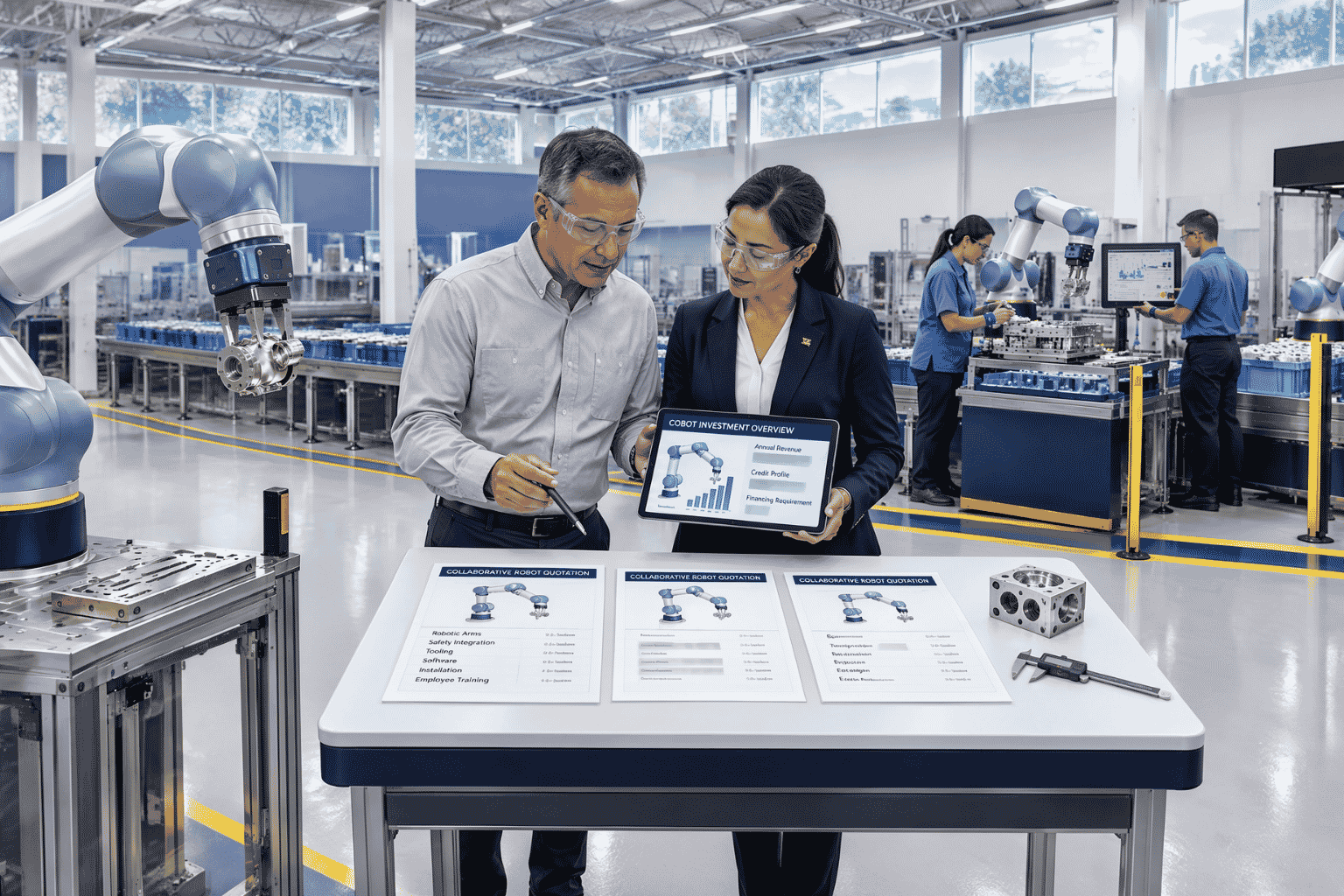 Cobot projects can combine equipment, tooling, integration, software and training costs that may require different financing treatment.