
Skip to content
  • Investor-Ready in 2026: What Venture Capital Actually Funds (and What It Rejects)
  • Secure Strategic Capital & Investor Partnerships with EINVC
  • Protect Every Deal with Expert Legal Counsel for M&A Transactions
  • Find the Right Funding Partner to Power Your Business Expansion
EINEdge Logo

EINEdge

The Official Insights HUB of Enterprise Industry Network (EIN)

EIN Insights

EIN Ecosystem
Venture Capital
How Much Runway Should a Startup Raise? Planning Enough Capital to Reach the Next Fundable Milestone 01
6 days ago6 days ago
02
EIN Ecosystem
Legal Counsel
Earnout in a Business Sale: What Buyers and Sellers Should Define Before Closing
03
Business Listings
EIN Ecosystem
Should You Show the Asking Price in a Business-for-Sale Listing?
04
Business Funding
EIN Ecosystem
Working Capital Loan With EIN: What Small Businesses Need to Qualify Before Applying
05
Business Consulting
EIN Ecosystem
Backlog Is Growing but Profit Is Not: How to Fix Delivery Bottlenecks Before Hiring More Staff
06
Business Brokers
EIN Ecosystem
How to Sell a Business Confidentially Without Employees, Customers, or Competitors Finding Out Too Early
  • Home
  • Global
    • Latest News
    • Politics
    • Economy
    • Energy & Climate
    • Business & People
  • The Future
    • AI & Automation
    • Emerging Technologies
    • Startups & Innovation
    • Future of Work
    • Next-Gen Mobility
  • Financial
    • Funding & Investment
    • Wealth & Capital
    • Markets & Macro
    • Banking & Fintech
    • Lending & Finance
    • Financial Insights
  • Industry Insights
    • Transportation & Logistics
    • Manufacturing & Engineering
    • Infrastructure & Development
    • Hospitality & Leisure
    • Healthcare & Life Sciences
    • Retail & Consumer Markets
    • General
  • Deals & M&A
    • Global M&A Trends
    • M&A News & Deals
    • Valuation & Strategy
    • Due Diligence & Compliance
    • Corporate Restructuring
    • Strategic Partnerships
  • For Businesses
    • Selling & Exits
    • Buying & Acquisitions
    • Investing & Ownership
    • Funding & Capital
    • Enterprise Exchange
  • EIN Ecosystem
    • Business Advisory
    • Business Brokers
    • Business Consulting
    • Business Funding
    • Business Listings
    • Legal Counsel
    • Venture Capital
  • EIN YouTube
  • EIN SocialEIN Social Media
EIN YouTube
  • Home
  • 2026
  • October
  • 30
  • Preparing for Investor Review? Make Sure Your Numbers Match Your Story

Trending News

Preparing for Investor Review? Make Sure Your Numbers Match Your Story
Collaborative Robot Financing: Equipment Loan or Term Loan for Cobots and Automation?
Holiday Inventory Financing: Working Capital Loan or Line of Credit Before Q4 Stock Peaks?
October 2026 SBA Loan Update: SOP 50 10 8.1 Is Now in Effect—What Borrowers Should Do Before Applying
  • EIN Social
  • EINVC Social
  • Investor Readiness

Preparing for Investor Review? Make Sure Your Numbers Match Your Story

Preparing for investor conversations?

Your pitch deck may explain the opportunity.

Your financial information needs to support that story.

Potential investors may compare what management says about growth, traction and capital needs with the numbers behind the company.

That makes consistency an important part of investor readiness.

Start With the Metrics That Matter to Your Business

Not every company should present exactly the same metrics.

The relevant numbers depend on the company’s stage, business model and industry.

Depending on the business, founders may need to understand areas such as:

  • Revenue
  • Revenue growth
  • Customer growth
  • Recurring or repeat business
  • Gross margin
  • Operating expenses
  • Cash position
  • Customer concentration
  • Other stage-specific operating metrics

The objective is not to fill the presentation with numbers. It is to know which numbers help explain the business.

Make Sure the Pitch and Financials Agree

If a pitch describes rapid growth, the supporting information should help explain that growth.

If the company says it has strong customer traction, founders should know what evidence supports that statement.

If the business is raising capital for expansion, the financial plan should connect that expansion to the proposed use of funds.

Inconsistency between the narrative and the numbers can create additional questions.

Know What Is Driving Revenue

For revenue-generating companies, the headline revenue number is only one part of the picture.

Founders may also need to understand what is driving that revenue.

Questions could include:

  • Which products or services generate revenue?
  • How concentrated is revenue among major customers?
  • Is revenue recurring, transactional or project-based?
  • What trends are visible over time?
  • What factors are influencing growth?

The right level of detail depends on the company and investor.

Understand Spending and Cash Requirements

Investor readiness also means understanding where the company’s money is going.

Founders should be able to explain major operating expenses and how those expenses relate to the company’s current stage and strategy.

This becomes especially important when the company is raising capital to extend runway, build a team, develop a product or expand operations.

Know Your Runway

For companies using more cash than they currently generate, runway can become an important part of the capital conversation.

Founders should understand their current cash position, expected spending and how long available resources may support the company’s plan.

A capital request should connect logically to that financial reality.

Be Ready to Explain the Forecast

Projections are based on assumptions.

Investors may therefore want to understand what those assumptions are.

For example:

  • What is expected to drive future revenue?
  • What hiring is assumed?
  • What sales or marketing investment is planned?
  • What product milestones are expected?
  • What costs are expected to increase?

The objective is not to guarantee future performance.

It is to show how management arrived at the forecast.

Connect the Capital Ask to the Financial Plan

The amount being raised should not exist separately from the company’s numbers.

The founder should be able to explain:

  • How much capital is being sought
  • Why that amount is appropriate
  • How the capital is expected to be used
  • What period or milestones it is intended to support

The capital request, use-of-funds plan and financial forecast should support the same underlying strategy.

Know the Weak Points Too

Investor readiness is not about pretending every metric is perfect.

A business may have customer concentration, uneven growth, developing margins, a short operating history or other risks.

Founders should understand those issues and be prepared to discuss them clearly.

A realistic explanation is generally more useful than avoiding a question that may emerge during review.

Prepare for Follow-Up Questions

A good investor conversation often produces additional questions.

Founders may be asked to explain:

  • Changes in revenue
  • Customer concentration
  • Expense growth
  • Cash requirements
  • Forecast assumptions
  • Capital allocation
  • Operating risks

Being able to answer those questions requires familiarity with the business beyond the presentation itself.

The Numbers Should Support the Story

An investor presentation can describe where the company is going.

The financial information helps explain where the company is today and what may be required to move forward.

The strongest preparation comes when the business story, financial story and capital strategy are aligned.

EIN Venture Capital provides a starting point for businesses preparing for investor conversations, capital readiness and potential capital-source alignment.

Investor mandates, interest, valuation, due diligence, terms and investment decisions vary by investor and opportunity. Financial projections are forward-looking estimates and do not guarantee future performance. An inquiry, meeting or introduction does not guarantee investment or funding.

Frequently Asked Questions

What financial information should founders understand before meeting investors?

The relevant information depends on the company, but founders may need to understand revenue, growth, operating expenses, cash position, runway, customer concentration, projections and other business-specific metrics.

Why do investors compare the pitch deck with financial information?

Financial and operating information can help investors evaluate whether the numbers support the company’s claims about traction, growth, capital needs and future plans.

Do financial projections need to be guaranteed?

No. Projections are estimates based on assumptions. Founders should be able to explain those assumptions rather than present forecasts as guaranteed outcomes.

Why should the capital ask match the financial plan?

The amount being raised, use of funds and expected milestones should connect logically to the company’s operating requirements and broader strategy.

Take the Next Step

Subscribe on YouTube:
https://www.youtube.com/@enterpriseindustrynetwork

Preparing your business for investor review?
Get Started with EIN Venture Capital:
https://www.einvc.com/get-capital/

Exit. Acquire. Invest.
Explore Enterprise Industry Network
https://enterpriseindustrynetwork.com/
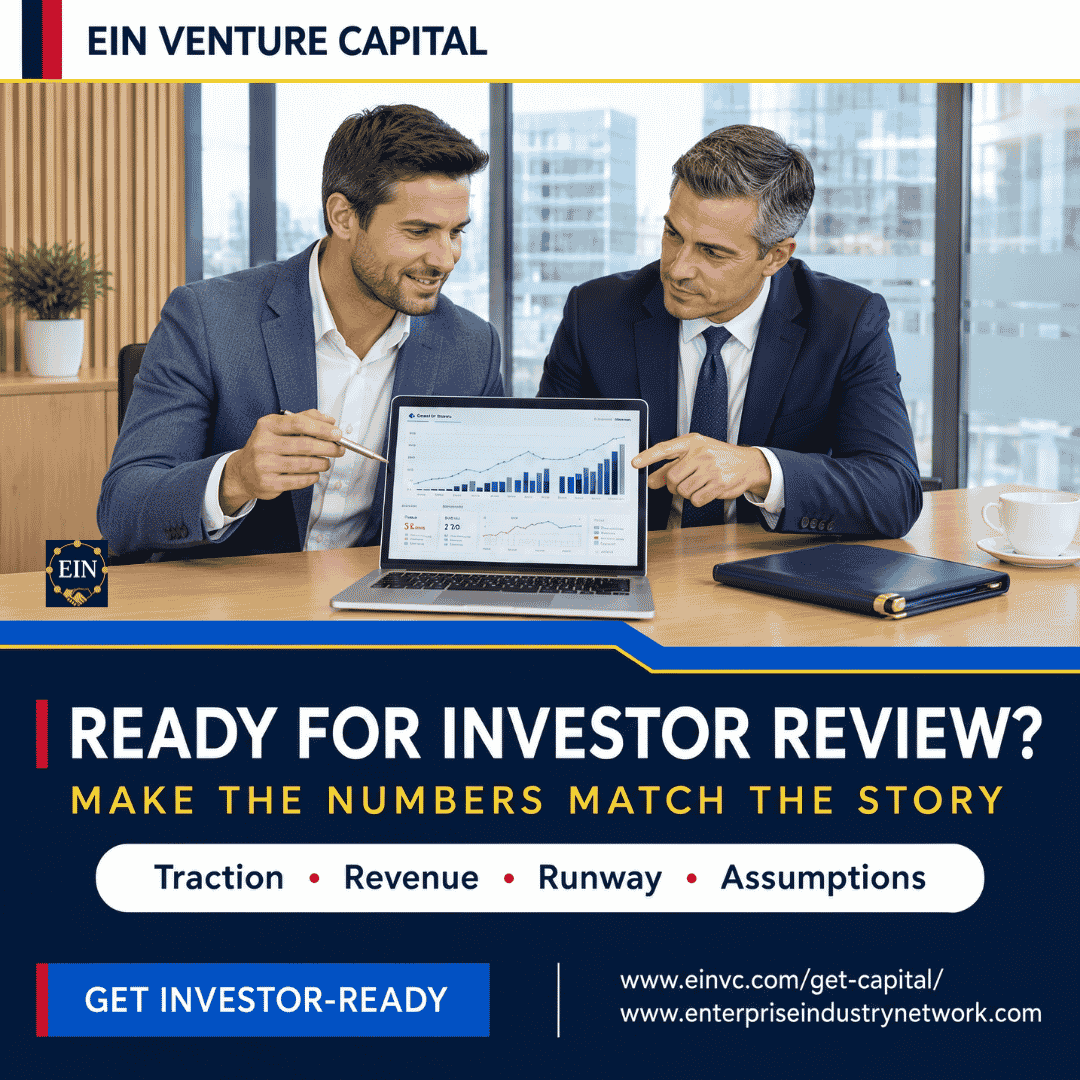
EIN Venture Capital graphic encouraging founders to align traction, revenue, runway and financial assumptions with the story presented to potential investors. Investor readiness includes understanding the numbers and assumptions supporting the company's business story and capital request.

Post navigation

Previous: Collaborative Robot Financing: Equipment Loan or Term Loan for Cobots and Automation?

Related News

EIN Business Brokers graphic encouraging business sellers to review price, structure and conditions when evaluating a Letter of Intent from a prospective buyer. A Letter of Intent may outline much more than price, including deal structure, financing, due diligence, timing and other proposed conditions.

Received a Letter of Intent to Buy Your Business? Read Beyond the Price

admin1 day ago1 day ago 0
EIN Business Funding graphic explaining why business financing applications may ask about revenue, cash flow, existing debt and use of funds. Business funding applications may use revenue, cash flow, debt and use-of-funds information to better understand the financing request.

Applying for Business Funding? Why Lenders Ask About Revenue, Debt and Use of Funds

admin2 days ago2 days ago 0
EIN Business Brokers graphic asking whether a business can operate without the owner and highlighting people, systems, customers and processes as exit-readiness factors. Reducing owner dependence can make a business easier for a prospective buyer to understand and transition to new ownership.

Could Your Business Run Without You? Why Owner Dependence Matters Before a Sale

admin3 days ago3 days ago 0
EIN Business Funding graphic for small-business owners exploring a working capital loan with an Employer Identification Number to support cash flow, inventory and operating needs. Working capital can address short-term operating needs, but the funding amount and structure should match the actual cash-flow requirement.

Working Capital Loan With an EIN: What Small Businesses Should Know Before Applying

admin4 days ago4 days ago 0

Popular News

1

Preparing for Investor Review? Make Sure Your Numbers Match Your Story

  • EIN Social
  • EINVC Social
2

Collaborative Robot Financing: Equipment Loan or Term Loan for Cobots and Automation?

  • AI & Automation
  • The Future
3

Holiday Inventory Financing: Working Capital Loan or Line of Credit Before Q4 Stock Peaks?

  • Industry Insights
  • Retail & Consumer Markets
4

October 2026 SBA Loan Update: SOP 50 10 8.1 Is Now in Effect—What Borrowers Should Do Before Applying

  • Global
  • Latest News
5

Business Acquisition Loan With Existing Company Debt: What Buyers Need to Recalculate Before Closing

  • Buying & Acquisitions
  • For Businesses
6

Business Loan With 700+ Credit and $250K Revenue: Which Funding Options Should You Compare?

  • Financial
  • Lending & Finance
7

Business Acquisition Financing: How Seller Add-Backs Affect the Financeable Purchase Price

  • Deals & M&A
  • Valuation & Strategy
8

Received a Letter of Intent to Buy Your Business? Read Beyond the Price

  • Business Sale & Acquisition Process
  • EIN Social

Highlights

Trending News

About

EINEdge is the official Insights Hub of the Enterprise Industry Network, featuring expert articles, industry intelligence, and growth perspectives across business advisory, brokerage, funding, legal, and venture capital sectors.

  • Facebook
  • LinkedIn
  • X
  • Instagram
  • YouTube

Explore EIN

  • Business Advisory
  • Business Brokers
  • Business Consulting
  • Business Funding
  • Business Listings
  • Legal Counsel
  • Venture Capital

Useful Links

  • EIN Connect
  • EIN-Live
  • About
    • About EINEdge
    • Mission & Vision
    • Inside EIN
© 2025 EINEdge All rights reserved. Powered by ITMagix