
SBA Loan With an EIN: Should Your Business Explore 7(a) or 504 Financing?
Searching for an SBA loan with an EIN?
Before asking whether your business qualifies, start with another question:
What exactly does the business need the financing for?
Two commonly discussed SBA financing paths—7(a) and 504—can serve very different purposes.
Understanding that difference can help a business owner explore the financing path that more closely matches the planned use of funds.
What Is an SBA 7(a) Loan?
The SBA 7(a) program is the U.S. Small Business Administration’s primary business loan program.
The SBA generally does not provide the business owner with the loan proceeds directly. Instead, eligible lenders make the loans, with the SBA providing a guaranty subject to program requirements.
One reason 7(a) financing is widely considered is the range of eligible business uses.
What Can SBA 7(a) Financing Be Used For?
Depending on the transaction and program requirements, 7(a) financing may potentially support purposes such as:
- Working capital
- Purchasing machinery or equipment
- Purchasing furniture, fixtures or supplies
- Acquiring, improving or refinancing qualifying real estate
- Refinancing certain existing business debt
- Complete or partial changes of business ownership
- Multiple-purpose business financing
That flexibility can make 7(a) relevant when the financing need includes several parts of the business rather than only one fixed asset.
What Is SBA 504 Financing?
The SBA 504 program is designed primarily for significant long-term fixed assets that support business growth.
504 transactions involve a Certified Development Company, commonly called a CDC, working with a senior lender as part of the financing structure.
The program is therefore different from simply applying for a conventional general-purpose business loan.
What Can SBA 504 Financing Be Used For?
504 financing is generally associated with qualifying major fixed assets such as:
- Commercial land
- Existing business buildings
- Construction of qualifying business facilities
- Renovation of qualifying property
- Long-term machinery
- Long-term equipment
For a business planning a major facility or equipment investment, the 504 program may be worth exploring.
504 Is Not a General Working-Capital Program
This distinction is important.
SBA 504 financing generally cannot be used for ordinary working capital or inventory.
If a business needs funds for payroll, inventory, general operating expenses or a combination of operating and acquisition needs, another financing structure—including potentially SBA 7(a)—may be more relevant.
7(a) vs. 504: Start With the Use of Funds
A simple way to begin comparing the programs is to look at what the business is trying to finance.
If the need includes several operating or transaction components, 7(a) may provide broader permitted uses.
If the project centers on a major qualifying fixed asset such as commercial property or long-term equipment, 504 may deserve closer consideration.
The exact fit depends on the business, project, lender and SBA requirements.
Example: Buying an Operating Business
Suppose an entrepreneur is acquiring an existing business.
The transaction may involve:
- Purchase of the business
- Equipment
- Inventory
- Working capital
- Transition expenses
Because the need can involve more than one type of expense, the financing structure should be evaluated based on the complete transaction rather than only the physical assets.
Example: Purchasing a Business Property
Now consider an established company purchasing a building for its own operations.
The project may involve commercial real estate and long-term equipment.
That type of fixed-asset project may lead the business to investigate whether SBA 504 financing is appropriate.
Specific eligibility and structure still need to be reviewed with qualified financing professionals.
What Does the EIN Have to Do With the SBA Loan?
Business owners frequently search for phrases such as “SBA loan with EIN” because they want financing connected to their business entity.
An Employer Identification Number helps identify the business during the financing process.
But having an EIN does not itself qualify a business for an SBA loan.
Depending on the program and lender, the financing review may also consider factors involving:
- The business and its operations
- Ability to repay
- Credit history
- Business financial performance
- Existing obligations
- The proposed use of funds
- The project or transaction structure
- SBA eligibility requirements
Do Not Choose a Program Only Because the Name Sounds Familiar
“SBA loan” is a broad phrase.
The correct question is not simply:
Can I get an SBA loan?
A more useful question is:
Which SBA financing structure, if any, fits what my business is actually trying to accomplish?
Prepare a Clear Use-of-Funds Plan
Before exploring financing, break the project into its individual components.
For example:
- Business acquisition
- Commercial property
- Equipment
- Inventory
- Working capital
- Renovation or expansion
- Other project costs
That makes it easier to determine whether a single financing product can support the complete need or whether a different structure should be considered.
Compare the Complete Financing Structure
Program selection should not be based only on whether financing appears available.
Business owners should understand the actual proposed structure, including:
- Loan amount
- Repayment term
- Interest rate and fees
- Equity contribution where required
- Collateral requirements where applicable
- Personal-guarantee requirements where applicable
- Closing requirements
- How the resulting payment fits business cash flow
Match the Capital to the Business Need
SBA 7(a) and 504 are not interchangeable labels for the same financing product.
The intended use of funds can be one of the most important differences.
7(a) can potentially support a broader mix of business needs.
504 is primarily designed around qualifying major fixed assets.
EIN Business Funding provides a starting point for U.S. business owners exploring SBA financing and other potential business funding solutions.
SBA program rules, lender requirements, eligibility, financing amounts, rates, fees, equity requirements, collateral, guarantees and terms vary by program, lender and applicant circumstances. An inquiry, prequalification or application does not guarantee financing.
Frequently Asked Questions
Can I get an SBA loan with an EIN?
An EIN can identify the business during an SBA financing application, but the EIN alone does not establish eligibility. The lender and applicable SBA program may consider the business, repayment ability, credit, financial condition, use of funds and other requirements.
What is the main difference between SBA 7(a) and SBA 504 financing?
SBA 7(a) can support a broader range of eligible business purposes, including working capital, equipment, real estate and ownership changes. SBA 504 is primarily focused on qualifying long-term fixed assets such as commercial property and major equipment.
Can SBA 504 financing be used for working capital?
Generally, no. SBA 504 financing is designed primarily for qualifying fixed assets and cannot generally be used for ordinary working capital or inventory.
Can SBA 7(a) financing be used to buy a business?
SBA 7(a) financing may be used for qualifying complete or partial changes of ownership, subject to lender and SBA requirements and the specific transaction.
Take the Next Step
Subscribe on YouTube:
https://www.youtube.com/@enterpriseindustrynetwork
Explore EIN Business Funding:
https://www.einbf.com/get-funded/
Exit. Acquire. Invest.
Explore Enterprise Industry Network
https://enterpriseindustrynetwork.com/
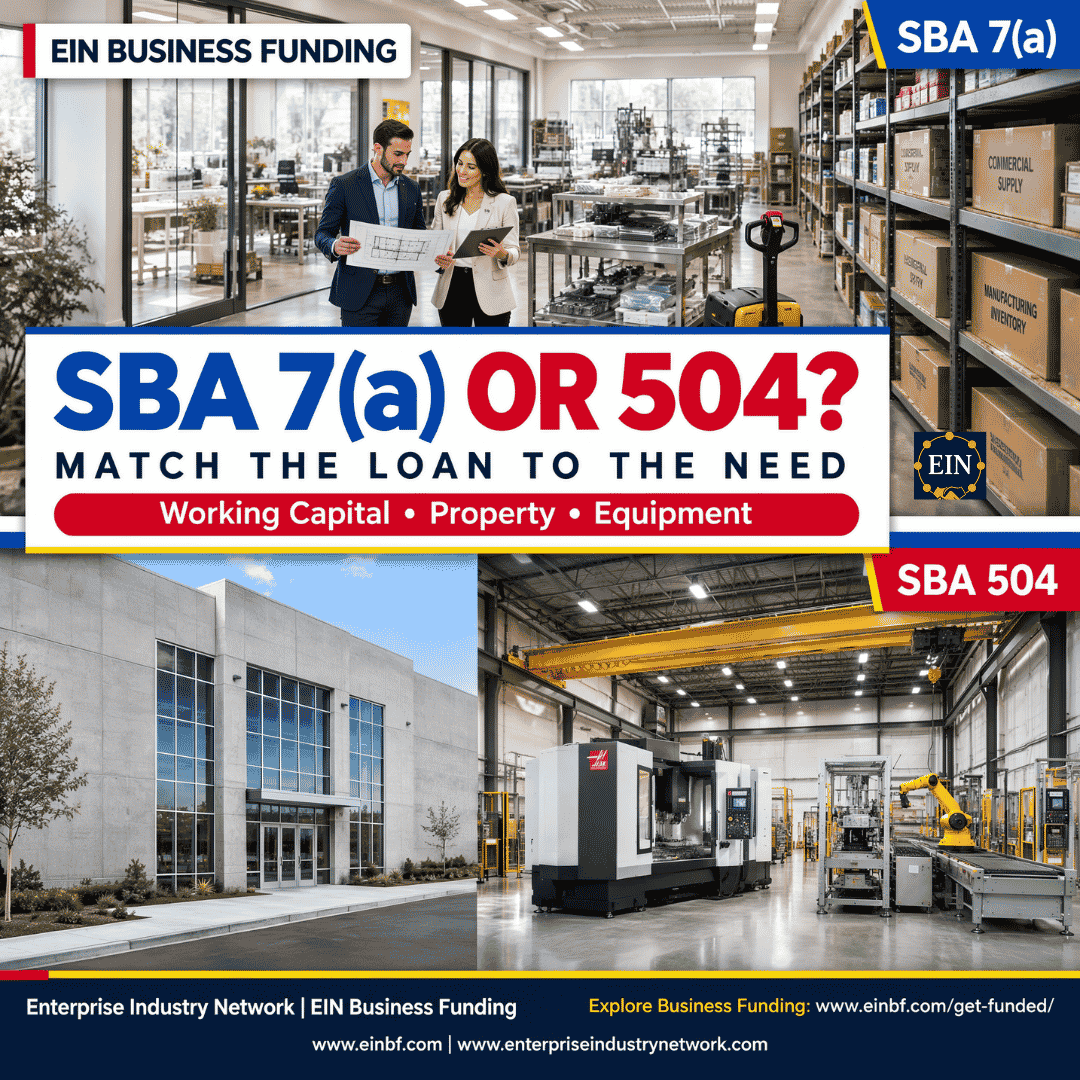 Professional EIN Business Funding social graphic visually comparing SBA 7(a) business uses with SBA 504 fixed-asset financing through business operations, commercial property and equipment imagery.