Received a Business Funding Offer? Compare the Structure Before You Accept
Received a business funding offer?
That can feel like the finish line.
But an offer is not just a dollar amount.
Before accepting financing, business owners should understand the complete structure of the obligation and how it fits the company’s cash flow.
Do Not Evaluate the Offer by Funding Amount Alone
Two offers for the same amount can create very different financial obligations.
The differences may involve:
- Repayment term
- Payment frequency
- Interest or financing cost
- Fees
- Collateral
- Personal guarantees
- Prepayment provisions
- Other conditions
The amount deposited into the business account is only one part of the decision.
Start With the Net Amount the Business Actually Receives
If fees or other charges are deducted at closing, the business may receive less cash than the headline financing amount.
For example, a stated funding amount and the actual amount available for business use may not always be identical.
Understand exactly how much cash the business will receive after applicable deductions.
Understand the Payment Amount
The payment should fit the company’s normal operating cash flow.
Ask:
- What is the required payment?
- When does repayment begin?
- How often is payment due?
- Is the payment fixed or potentially variable?
A financing offer can look manageable based on the total amount while creating significant pressure if the recurring payment is too high.
Payment Frequency Matters
Not every financing product uses the same payment schedule.
Depending on the product, payments may be structured monthly or on another schedule.
The business should understand how frequently money will leave its account and whether that timing aligns with incoming revenue.
A company that receives most customer payments monthly may experience financing differently from one with steady daily or weekly receipts.
Look at the Repayment Term
The repayment period affects both the size of individual payments and how long the business carries the obligation.
A shorter term may increase payment pressure.
A longer term may reduce the periodic payment but extend the financing relationship.
The appropriate structure depends on the business need, product and overall economics of the offer.
Understand the Total Cost
Do not stop at the stated interest rate or financing charge.
Ask what the business is expected to repay in total under the proposed structure.
That can help the owner compare the financing cost with the expected benefit of using the funds.
If the capital is being used for inventory, equipment, expansion or another business purpose, the financing should make economic sense within that plan.
Review Fees Carefully
Financing may include fees depending on the product and provider.
Potential charges could affect either the amount received or the overall cost.
Before accepting, understand:
- Origination or closing fees, if applicable
- Documentation or administrative fees, if applicable
- Other required charges
- Whether any fees are deducted upfront
Specific fees vary by financing product and provider.
Understand Collateral Requirements
Some financing may be unsecured, while other products may involve business assets or other collateral.
If collateral is required, understand what property is involved and what obligations are created.
This is especially important when the business relies on those assets for daily operations.
Review Personal Guarantee Requirements
Depending on the financing product and provider, one or more owners may be asked to provide a personal guarantee.
A personal guarantee can create obligations beyond the business entity itself.
Owners should understand what they are agreeing to before signing.
Qualified legal or financial advice may be appropriate when evaluating significant obligations.
Check Prepayment Terms
A business may later want to repay financing earlier than scheduled.
Before accepting the offer, understand whether early repayment is permitted and how it affects the remaining financing cost.
Do not assume that paying earlier will always reduce the total cost in the same way across all products.
The contract controls.
Match the Financing Term to the Business Need
The useful life of the financing should make sense for the purpose.
For example, financing a long-lived piece of equipment may justify a different repayment structure than covering a short-term working-capital gap.
The goal is to avoid paying for a short-lived need long after the benefit has disappeared—or creating an unnecessarily aggressive repayment schedule for a longer-term investment.
Compare the Payment With Real Cash Flow
Do not evaluate affordability using revenue alone.
Revenue is not the same as available cash.
The business still has to pay:
- Payroll
- Rent
- Inventory
- Suppliers
- Taxes
- Existing debt
- Insurance
- Other operating expenses
The financing payment has to fit alongside those obligations.
Stress-Test the Payment
Ask what happens if the business has a slower month.
Would the payment still be manageable?
What if a major customer pays late?
What if seasonal revenue arrives later than expected?
A financing decision should not depend on every business assumption going perfectly.
Compare Offers on the Same Basis
If multiple financing options are available, compare them using the same questions.
For each offer, identify:
- Gross financing amount
- Net amount received
- Payment amount
- Payment frequency
- Repayment term
- Total expected repayment
- Fees
- Collateral requirements
- Personal guarantee requirements
- Prepayment provisions
A side-by-side comparison can make differences much easier to see.
The Lowest Payment Is Not Automatically the Best Offer
A lower recurring payment may look attractive.
But it could be associated with a longer repayment period or a different overall cost.
Likewise, the offer with the largest funding amount is not automatically the best option.
The best fit depends on what the business needs and what it can responsibly support.
Do Not Let Urgency Replace Review
Some financing needs are time-sensitive.
The business may need inventory, equipment or working capital quickly.
But speed should not eliminate basic review.
Before signing, make sure the owner understands the core financial and contractual obligations.
An Offer Is Still a Business Decision
Receiving a funding offer does not mean the business has to accept it.
The owner should decide whether:
- The amount solves the actual need
- The payment is manageable
- The cost makes economic sense
- The repayment period fits the use of funds
- The collateral or guarantee requirements are acceptable
- The overall structure supports rather than strains the business
Financing should serve the business strategy—not become a new problem.
EIN Business Funding provides a starting point for U.S. business owners exploring potential funding options and evaluating financing structures.
Funding availability, eligibility, limits, rates, costs, fees, collateral, personal guarantees, payment schedules and terms vary by provider, product and applicant circumstances. An inquiry, prequalification, application or offer does not guarantee financing or mean that a particular financing structure is appropriate for every business.
Frequently Asked Questions
What should I compare in a business funding offer?
Review the amount received, required payment, payment frequency, repayment term, overall cost, applicable fees, collateral, personal guarantee requirements and prepayment provisions.
Is the biggest business funding offer always the best?
No. A larger offer can also create a larger repayment obligation. The financing should match the business need and fit the company’s cash flow.
Why does payment frequency matter?
Payment frequency affects how often cash leaves the business. The schedule should be evaluated alongside the company’s normal revenue and operating cash-flow pattern.
Can I repay business financing early?
That depends on the financing agreement. Some products permit early repayment, but the effect on financing costs or other obligations varies. Review the actual contract before accepting.
Take the Next Step
Subscribe on YouTube:
https://www.youtube.com/@enterpriseindustrynetwork
Explore EIN Business Funding:
https://www.einbf.com/get-funded/
Exit. Acquire. Invest.
Explore Enterprise Industry Network
https://enterpriseindustrynetwork.com/
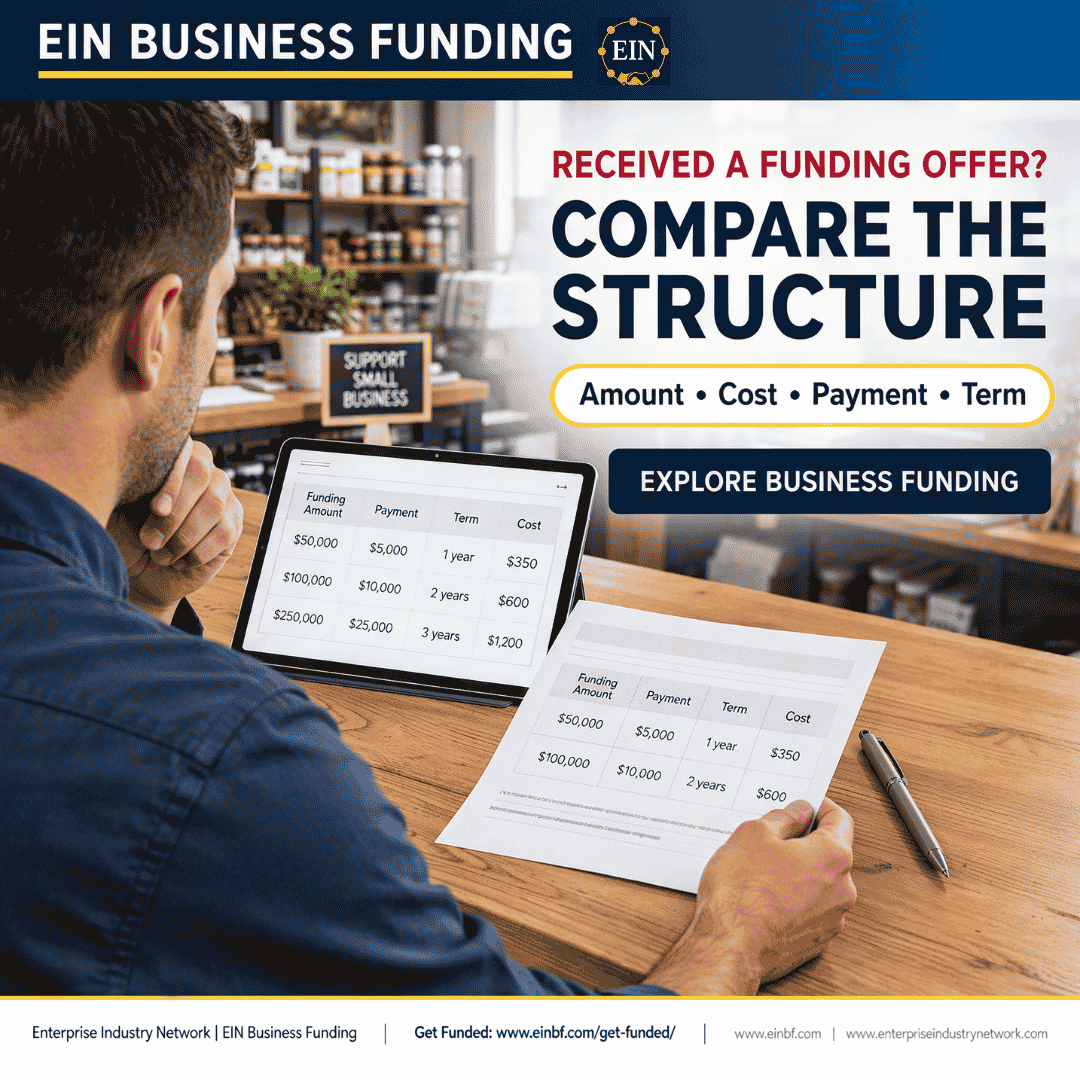 A business funding offer should be evaluated by more than the financing amount, including payment, term, cost and other obligations.