
Business Loan With 600 Credit: Can Strong Revenue and Bank Deposits Improve Your Funding Options?
A business owner with approximately 600 personal credit may assume that every financing option is unavailable. That conclusion can be too broad.
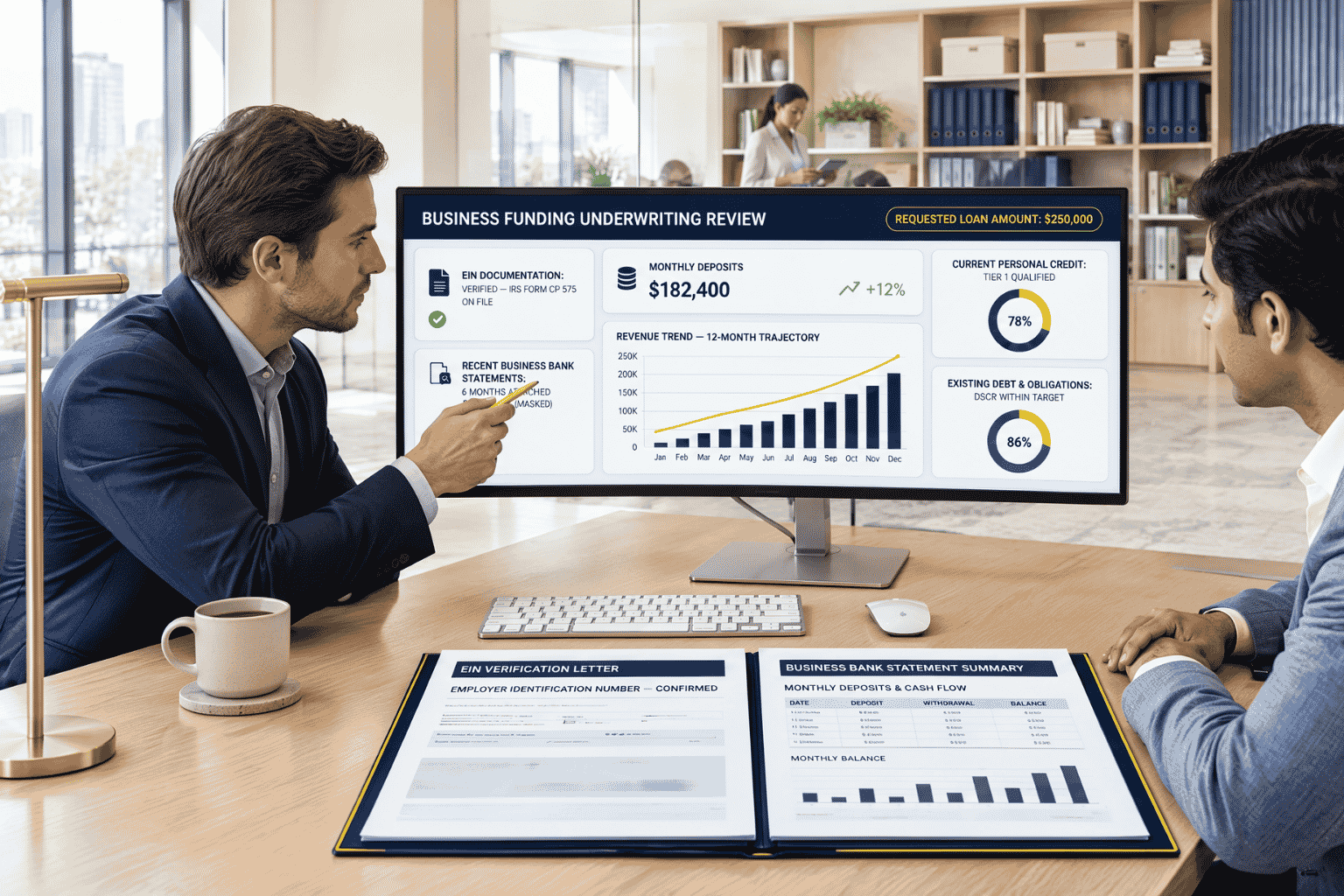
Credit matters, but different small-business financing categories use different underwriting profiles. For some alternative or working-capital products, business revenue, operating history, bank deposits and existing obligations can also be important.
If your company currently needs capital and you know your approximate credit score, annual revenue and time in business, complete the EIN Business Funding Quick Lead Pre-Qualification using your current business information.
Is 600 Credit Enough for a Business Loan?
Potentially for some financing categories, but not universally.
The EIN Business Funding guidance identifies approximately 600+ personal credit, six to twelve months in business and around $50,000 to $100,000 in annual revenue as common working-capital benchmarks.
Online or alternative small-business financing may also use approximately 600 to 680+ personal credit, six to twelve months in business and roughly $50,000 to $250,000+ annual revenue as general screening ranges.
Actual requirements vary by provider and complete borrower profile.
Why Strong Revenue Can Help
Revenue shows that the business is producing real commercial activity. A lender may use annual revenue to understand the size of the operation and whether the requested financing amount appears reasonable.
However, revenue by itself is not repayment capacity.
A company generating $300,000 in annual sales but operating at very thin margins can present differently from a business generating $150,000 with strong positive cash flow and little existing debt.
Why Bank Deposits Matter
Recent deposits can provide a more current view of the business than an annual revenue number alone.
Consistent deposits may help show that customers are actively paying the company and that the operation continues generating cash.
For online or alternative financing, business bank statements and deposit consistency can become especially relevant.
What If Revenue Is Strong but Credit Is Around 600?
A strong business profile may make some financing categories worth evaluating even when the owner does not meet traditional-bank credit expectations.
The appropriate path depends on the complete situation: business age, monthly deposits, annual revenue, cash flow, industry, debt and use of funds.
What Traditional Financing May Still Be Difficult?
Traditional bank lines of credit generally use stronger borrower profiles. The EIN Business Funding guidance identifies approximately 720+ personal credit, one to two years in business, $100,000 to $250,000+ annual revenue and positive cash flow as common benchmarks.
That does not mean every bank uses identical standards, but it illustrates why a 600-credit borrower may need to evaluate different financing categories.
Could a Term Loan Be Considered?
Potentially. Common term-loan benchmarks in the EIN Business Funding guidance include approximately 600 to 680+ credit, one or more years in business, $100,000+ annual revenue and positive cash flow.
A business at the lower end of the credit range may need compensating strengths such as stronger operating history, revenue or cash-flow consistency, depending on the provider.
Existing Debt Can Matter More Than Owners Expect
A company may have healthy deposits but already be carrying several obligations.
Prepare open business credit cards, lines of credit and loans with the current balances, limits where applicable and open dates.
Existing debt reduces the amount of cash available to support another financing payment.
What Is the Capital Actually For?
Funding providers need to understand the use of funds.
- Inventory
- Payroll
- Equipment
- Expansion
- Supplier payments
- Marketing tied to established operations
- Another clearly defined business expense
A specific $40,000 inventory requirement is more useful than asking for the maximum amount the business can obtain.
Do Not Use Revenue to Hide a Cash-Flow Problem
Strong sales do not automatically mean healthy cash flow. High operating expenses, customer-payment delays and existing debt can consume significant liquidity.
The company should understand how much cash is actually available after normal expenses.
What Should a 600-Credit Borrower Prepare?
- Current personal credit score
- Business formation date
- Annual revenue
- Recent monthly deposits
- Business bank statements
- Existing business debt
- Requested amount
- Specific use of funds
- Legal business name and EIN
Do Not Apply Blindly to Every Financing Product
A 600-credit borrower with one year in business and consistent deposits should not necessarily pursue the same financing products as a 740-credit borrower with five years of operating history.
Understanding the current profile first can help focus the funding search on options that are more realistic for the business.
A Lower Credit Score Is One Factor—not the Entire Business
Credit can materially affect financing, pricing and eligibility, but it should be considered alongside the company’s real operating performance.
The objective is not to find a lender that ignores credit. It is to determine whether the business has enough compensating strengths to make an appropriate financing category worth reviewing.
FAQs
Can a business owner with around 600 credit get business funding?
Potentially. Some working-capital, online or alternative financing categories use credit ranges beginning around 600, although eligibility depends on the complete business profile.
Can strong revenue make up for weaker credit?
Strong revenue can improve the overall profile, but it does not erase credit, cash-flow, debt or operating-history requirements.
Why are business bank deposits important?
Recent deposits can help demonstrate current operating activity and cash-flow consistency, particularly for online or alternative financing providers.
 Credit matters, but business revenue, deposits, operating history and existing debt can also shape funding options.