Lender-Agnostic Business Funding Strategy: How to Compare Capital Paths Before Choosing a Lender
Should a business owner begin a funding search by choosing a lender—or by first determining what type of capital actually fits the business?
A lender-agnostic business funding strategy starts with the company’s need rather than one lender, one financing product, or one predetermined source of capital. The objective is to understand the purpose, amount, timing, repayment capacity, financial condition, and broader business goal before narrowing the conversation to a particular funding provider.
In this long-form educational video, EIN Business Funding (EINBF), part of Enterprise Industry Network (EIN), explains why businesses can benefit from comparing capital paths before selecting a lender and how different financing structures can serve very different purposes.
What Does Lender-Agnostic Business Funding Mean?
A lender-agnostic approach means evaluating the business funding need without assuming in advance that one lender or product is automatically the right solution.
Instead of beginning with:
- “Which lender should I apply to?”
- “Can I get a term loan?”
- “How quickly can I get approved?”
the business begins with questions such as:
- Why is capital needed?
- How much is actually required?
- When is the money needed?
- How long will the capital be used?
- What will repay the financing?
- What obligations already exist?
- What financing structure fits the underlying need?
Only after those questions are reasonably clear does it become useful to compare lenders and funding sources.
Why Starting With One Lender Can Narrow the Funding Conversation
Different lenders specialize in different products, industries, transaction sizes, credit profiles, collateral structures, and repayment models.
If a business begins with only one provider, the conversation may naturally become centered on the products that provider offers rather than the broader range of structures that could potentially fit the company.
That does not mean a particular lender is unsuitable. It means the business should understand the capital need before allowing product availability to define the solution.
Start With the Purpose of the Capital
The first question should be: What is the business trying to accomplish?
Potential funding purposes may include:
- Managing short-term working capital.
- Purchasing equipment.
- Funding inventory.
- Covering a receivables timing gap.
- Supporting seasonal demand.
- Acquiring another business.
- Refinancing existing obligations.
- Preparing a company for a future sale.
- Supporting expansion.
- Addressing another defined business need.
These needs can require very different capital structures.
Determine the Required Funding Amount
The business should calculate the amount needed rather than automatically seeking the largest amount available.
That calculation may include:
- Direct project cost.
- Working-capital requirements.
- Existing cash available.
- Transaction expenses.
- Contingency reserves.
- Expected timing of incoming cash.
Borrowing too little may fail to solve the problem, while borrowing substantially more than necessary may create avoidable financing cost and repayment pressure.
Understand the Timing of the Funding Need
Timing can materially affect the appropriate financing path.
A temporary cash-flow gap expected to resolve within a short period is different from an equipment purchase expected to produce value over several years.
Owners should consider:
- When the capital is required.
- How quickly the business will use it.
- When the expected economic benefit begins.
- How long repayment should reasonably take.
Match the Capital Term to the Business Need
One of the central principles of financing strategy is matching the repayment horizon to the purpose of the capital.
Short-term capital may make sense for:
- Temporary working-capital gaps.
- Seasonal inventory.
- Receivables timing.
- Short-duration operating needs.
Longer-term financing may be more appropriate for:
- Productive equipment.
- Expansion.
- Major technology investments.
- Business acquisitions.
- Other assets or projects expected to produce benefits over several years.
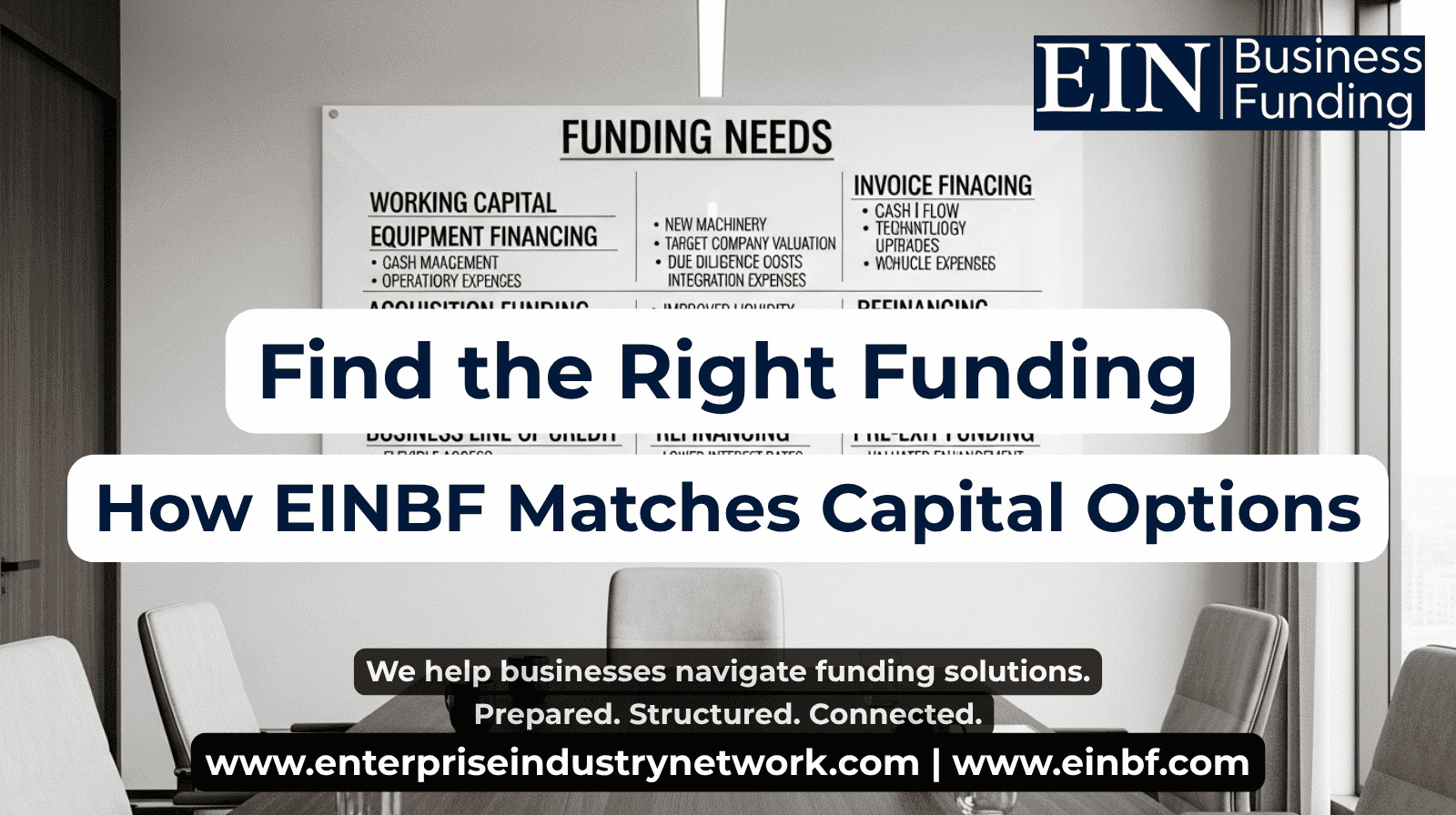
Working Capital Financing
Working capital financing may help address temporary operating needs such as:
- Payroll.
- Inventory.
- Vendor payments.
- Seasonal expenses.
- Short-term cash-flow timing.
It may be useful when the underlying business is healthy but cash inflows and outflows occur at different times.
Business Line of Credit
A business line of credit may provide flexible revolving access to capital for recurring or variable short-term needs.
It may be useful for:
- Seasonality.
- Receivables gaps.
- Inventory purchases.
- Payroll timing.
- Short-term opportunities.
The business should still monitor utilization, cost, repayment, and available credit carefully.
Equipment Financing
Equipment financing is generally structured around a productive asset such as:
- Machinery.
- Vehicles.
- Technology.
- Medical equipment.
- Construction equipment.
- Manufacturing assets.
It can allow the business to acquire needed assets while preserving cash for other operating requirements.
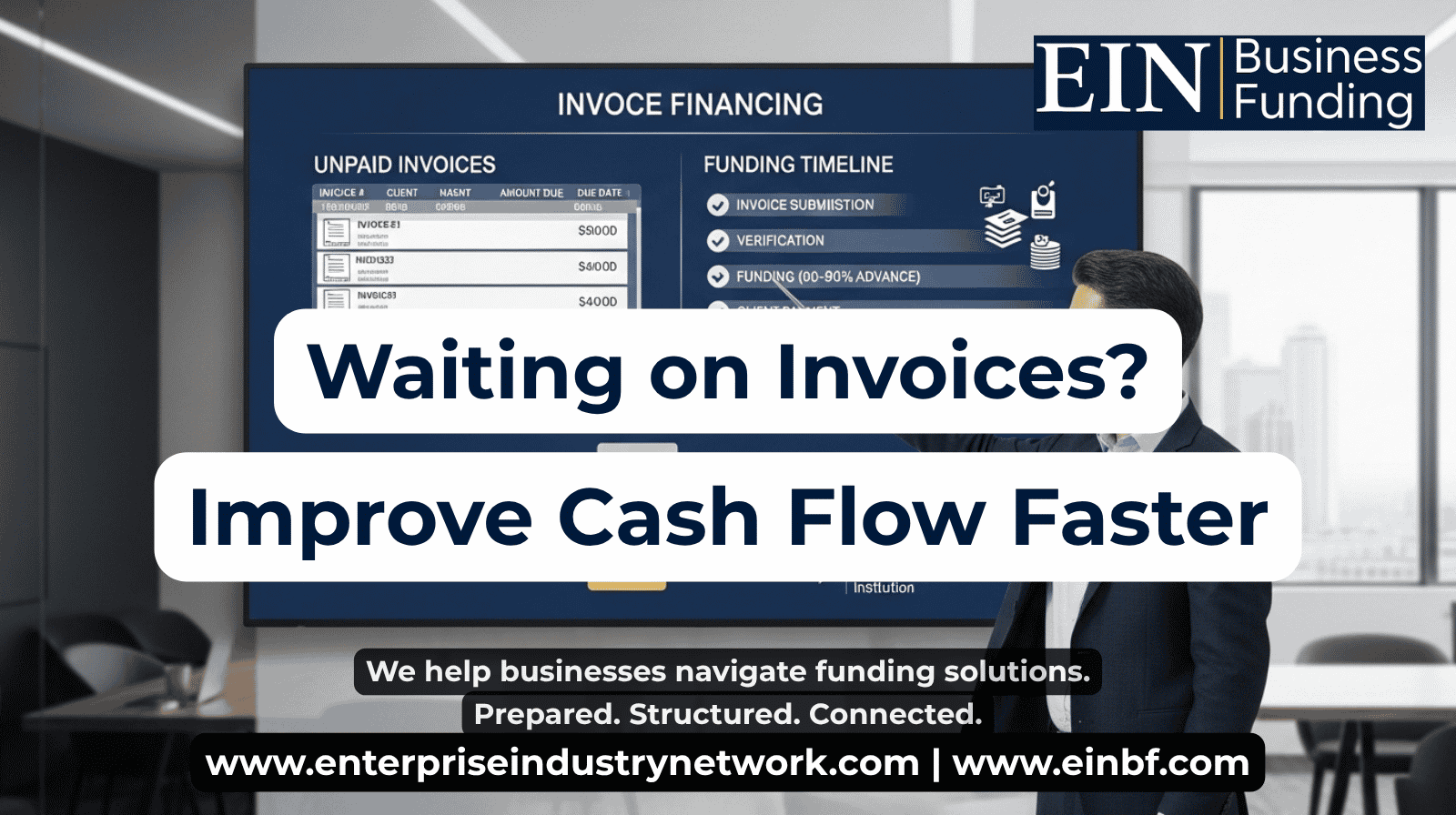
Invoice Financing
Invoice financing may be worth evaluating when the primary funding problem comes from unpaid customer receivables.
Instead of waiting for customers to pay according to normal commercial terms, the business may be able to access capital against eligible invoices.
The structure may depend on:
- Invoice quality.
- Customer creditworthiness.
- Invoice aging.
- Customer concentration.
- Financing cost.
Business Acquisition Financing
Acquisition financing serves a very different purpose from ordinary operating capital.
A business purchase may involve:
- Buyer equity.
- Bank financing.
- SBA-related financing.
- Seller financing.
- Investor capital.
- Working capital.
- Other transaction-specific capital.
The financing structure should account for both the purchase price and the financial needs of the acquired business after closing.
Business Refinancing
Refinancing may be appropriate when the primary issue is the company’s existing debt structure.
Possible objectives may include:
- Reducing repayment pressure.
- Consolidating obligations.
- Replacing expensive financing.
- Extending maturity.
- Improving cash-flow predictability.
Adding another unrelated loan may not solve a problem that is fundamentally caused by the existing debt structure.
Pre-Exit Funding
A company preparing for a future sale may have funding needs related to:
- Working capital.
- Equipment upgrades.
- Deferred maintenance.
- Technology.
- Financial cleanup.
- Operational stabilization.
The capital should support a genuine business improvement without unnecessarily complicating buyer due diligence or the eventual transaction.
Different Funding Products Solve Different Problems
One of the biggest mistakes in business financing is treating every capital need as interchangeable.
A line of credit is not simply a smaller version of an equipment loan. Invoice financing is not merely another term loan. Acquisition financing involves considerations that ordinary working-capital financing may not.
Understanding the purpose of each structure helps a business avoid forcing the wrong product onto the wrong problem.
Evaluate Business Cash Flow
The company’s ability to support repayment is central to funding fit.
Owners should understand:
- Revenue.
- Gross margin.
- Operating expenses.
- Available cash flow.
- Existing debt service.
- Seasonality.
- Working-capital requirements.
A financing product that appears attractive in isolation may be inappropriate if its repayment schedule places excessive pressure on actual business cash flow.
Review Existing Debt Before Adding New Capital
A lender-agnostic analysis should include every existing financing obligation.
The business should know:
- Outstanding balances.
- Monthly or periodic payments.
- Interest or financing costs.
- Collateral.
- Remaining maturity.
- Personal guarantees.
- Existing liens.
In some situations, the correct solution may be to restructure current debt rather than simply add another obligation.
Repayment Structure Matters
Two financing offers can have similar funding amounts but very different effects on the business.
Owners should compare:
- Monthly payments.
- Weekly payments.
- Daily payments where applicable.
- Amortization.
- Maturity.
- Balloon payments.
- Prepayment requirements.
The payment structure should align as closely as possible with the company’s operating cash cycle.
Compare Total Cost, Not Just Interest Rate
Rate is important, but it is only one part of financing economics.
Owners should also consider:
- Origination fees.
- Closing costs.
- Annual fees.
- Draw fees.
- Prepayment penalties.
- Other financing charges.
- Total repayment amount.
A lower stated rate does not necessarily mean the lowest overall cost.
Collateral Can Change the Funding Decision
Some financing structures may require collateral such as:
- Accounts receivable.
- Inventory.
- Equipment.
- Real estate.
- Other business assets.
Owners should understand whether assets are already pledged and how new liens could affect future flexibility.
Personal Guarantees Should Be Understood Clearly
Depending on the product and provider, owners may be required to provide personal guarantees.
That means funding should be evaluated not only at the company level but also in terms of any personal obligation being assumed.
Funding Speed Is Not the Same as Funding Fit
Fast access to capital can be valuable when the business has an urgent need.
However, speed should be evaluated alongside:
- Cost.
- Term.
- Repayment pressure.
- Collateral.
- Product suitability.
- Long-term financial impact.
The fastest available capital is not automatically the most appropriate capital.
Approval Amount Is Not the Same as Recommended Borrowing
A business may qualify for more capital than it actually needs.
Owners should distinguish between:
- Maximum available funding.
- Actual business requirement.
- Amount the business can comfortably repay.
Responsible financing begins with the business need rather than the maximum approval.
Documentation Readiness Can Affect Available Paths
Different funding products may require different levels and types of documentation.
Potential records can include:
- Bank statements.
- Profit-and-loss statements.
- Balance sheets.
- Business tax returns.
- Debt schedules.
- Accounts receivable aging.
- Equipment quotes.
- Acquisition documents.
- Ownership records.
Businesses that prepare documentation in advance may be better positioned to compare appropriate structures rather than limiting themselves to whatever can be obtained with minimal preparation.
Different Business Stages May Require Different Funding Paths
Funding fit can change as the company evolves.
A growing business may prioritize:
- Inventory.
- Equipment.
- Hiring.
- Working capital.
A mature company may focus on:
- Refinancing.
- Acquisitions.
- Recapitalization.
- Exit preparation.
The financing strategy should evolve with the company rather than remain tied permanently to one product.
Funding Strategy for Seasonal Companies
Seasonal businesses may need flexible capital that expands during high-expense periods and can be repaid during stronger revenue periods.
Potential structures may include:
- Working-capital financing.
- Business lines of credit.
- Other short-term facilities.
Historical seasonality should guide the decision.
Funding Strategy for Businesses With Slow-Paying Customers
Businesses carrying substantial accounts receivable may compare:
- Invoice financing.
- Business lines of credit.
- Working-capital financing.
The correct path may depend on customer quality, invoice aging, financing cost, and how frequently the need recurs.
Funding Strategy for Productive Assets
When the company needs machinery, vehicles, or another defined asset, equipment financing may preserve working capital more effectively than using a general operating facility.
The financing term can also be aligned more closely with the expected useful life of the asset.
Funding Strategy for Acquisitions
Buying a business requires a transaction-level analysis.
The buyer may need to evaluate:
- Purchase price.
- Equity contribution.
- Target-company cash flow.
- Seller financing.
- Working capital.
- Post-closing debt service.
This is fundamentally different from choosing a general operating loan.
Funding Strategy for Existing Debt Problems
When financial pressure comes from existing debt, adding more debt may make the problem worse.
The business may need to evaluate:
- Refinancing.
- Debt consolidation.
- Recapitalization.
- Other restructuring approaches.
Build a Capital Decision Matrix
Business owners can compare financing paths across several dimensions.
- Purpose: What problem is being solved?
- Amount: How much capital is required?
- Timing: When is the money needed?
- Duration: How long will the capital be used?
- Repayment: What cash flow will repay it?
- Cost: What is the total financing expense?
- Collateral: What assets may be pledged?
- Flexibility: Can capital be redrawn or prepaid?
- Risk: What happens if expectations change?
Compare Products Before Comparing Providers
A practical lender-agnostic sequence is:
- Define the business need.
- Identify potentially appropriate financing structures.
- Eliminate structures that do not fit.
- Compare the economics and risks of the remaining paths.
- Then compare lenders or funding providers within those categories.
This keeps the financing conversation focused on suitability rather than availability alone.
A Lender-Agnostic Approach Is Not Anti-Lender
The purpose is not to avoid lenders or suggest that lenders are interchangeable.
Different financing providers can have meaningful differences in:
- Eligibility.
- Pricing.
- Industries served.
- Transaction size.
- Documentation.
- Funding speed.
- Collateral.
- Repayment terms.
The point is simply to determine what kind of financing is needed before selecting the provider.
Avoid Product-First Financing Decisions
A product-first approach can lead to situations where:
- Short-term debt finances a long-term asset.
- A fixed loan is used for highly variable needs.
- A revolving facility becomes permanently maxed out.
- Working capital is consumed by equipment purchases.
- Additional borrowing is used instead of restructuring existing debt.
Funding fit helps reduce these mismatches.
Consider the Downside Scenario
Before accepting capital, owners should ask what happens if:
- Revenue is lower than expected.
- A customer pays late.
- Growth takes longer.
- The equipment does not generate expected results.
- A business acquisition underperforms.
- A planned sale is delayed.
A financing structure should ideally remain manageable under reasonable downside conditions.
Funding Should Support the Business Strategy
Capital is a financial tool, not the objective itself.
The funding path should support a broader business objective such as:
- Stability.
- Growth.
- Asset acquisition.
- Liquidity.
- Acquisition.
- Debt restructuring.
- Exit preparation.
The strongest financing decision connects the capital directly to that objective.
How EIN Business Funding Uses a Lender-Agnostic Perspective
EIN Business Funding (EINBF), part of Enterprise Industry Network, helps business owners and buyers think through the capital need before focusing on one lender or one financing product.
Depending on the situation, potential paths may include working capital, business lines of credit, equipment financing, invoice financing, acquisition financing, refinancing, pre-exit funding, and other qualified business funding structures.
The objective is to evaluate purpose, amount, timing, current financial position, repayment capacity, existing obligations, documentation readiness, and broader business goals before pursuing a specific capital source.
Start With the Funding Need—Not Just the Lender
Compare capital structures based on business purpose, timing, cash flow, repayment capacity, existing debt, cost, and long-term goals before choosing a funding provider.
Frequently Asked Questions
What does lender-agnostic business funding mean?
A lender-agnostic approach begins by identifying the business need and appropriate financing structure before choosing a specific lender or funding provider.
Why should a business compare funding structures before lenders?
Different financing structures serve different purposes. Determining whether the business needs working capital, revolving credit, equipment financing, invoice financing, acquisition financing, refinancing, or another structure can narrow the search to providers that actually fit the need.
Does lender-agnostic funding mean all lenders are the same?
No. Providers can differ significantly in eligibility, cost, terms, collateral, documentation, funding speed, and industries served. The lender-agnostic approach simply determines the appropriate capital path before selecting among providers.
What factors should a business compare when choosing financing?
Important considerations can include funding purpose, amount, timing, repayment capacity, cash flow, existing debt, total financing cost, payment frequency, collateral, personal guarantees, documentation requirements, and future business objectives.
Is the fastest business funding option always the best option?
No. Speed can be important, but a fast financing structure may carry different costs, repayment requirements, or risks. Funding should be evaluated based on overall fit rather than speed alone.
How does EIN Business Funding help businesses evaluate financing paths?
EIN Business Funding helps businesses consider the underlying capital need and evaluate potential financing structures before focusing on a single lender or product. Potential paths may include working capital, lines of credit, equipment financing, invoice financing, acquisition financing, refinancing, and other qualified business funding solutions.
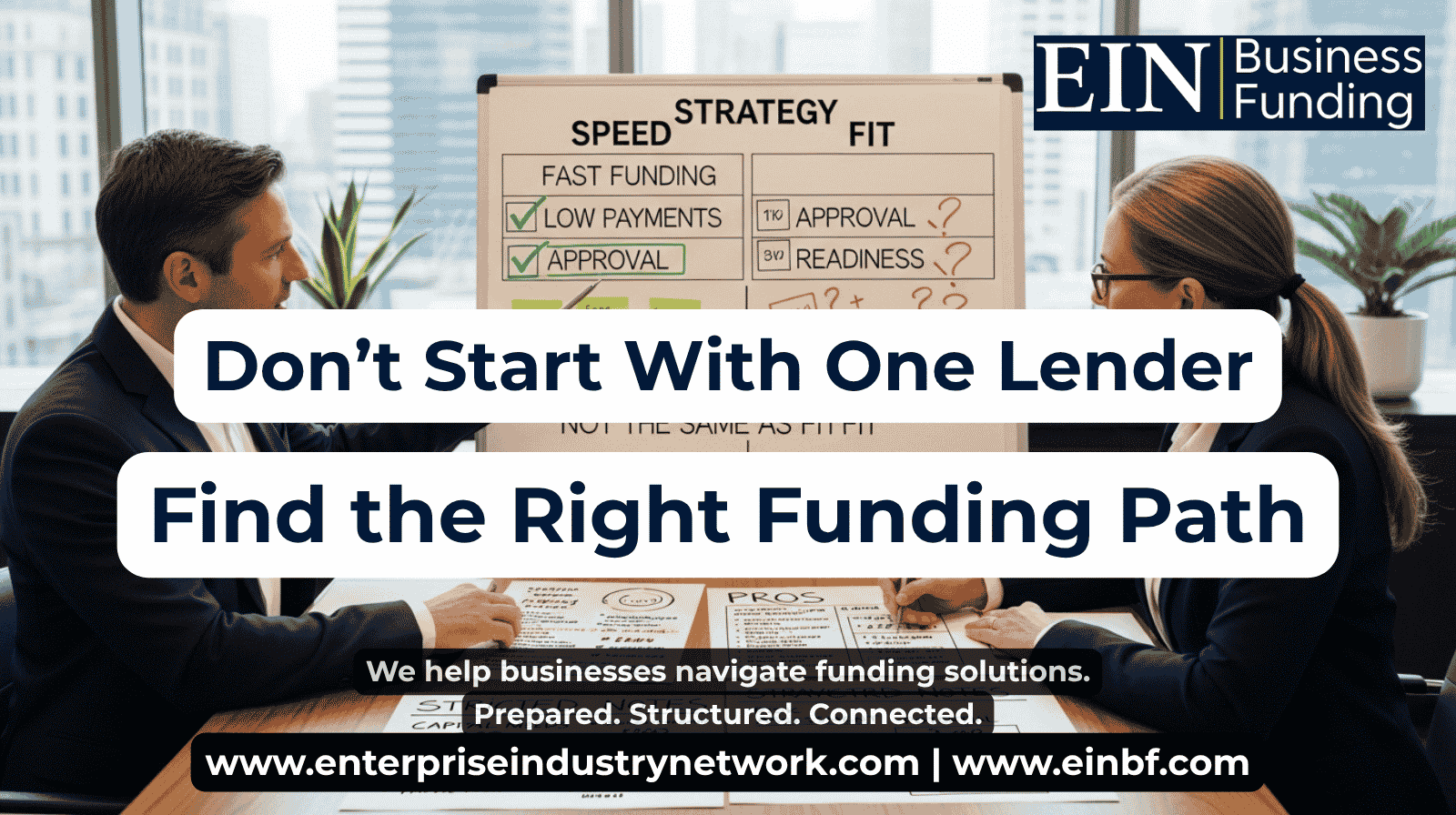 A lender-agnostic funding strategy starts with the business need, capital structure, repayment capacity, timing, and cash flow before comparing individual lenders or funding providers.