Invoice Financing Strategy: How Businesses Turn Unpaid Invoices Into Working Capital
How can a business improve cash flow when customers take weeks or months to pay outstanding invoices? Invoice financing can help eligible businesses access capital against unpaid receivables instead of waiting for the normal customer payment cycle to run its course.
That can help address the timing gap between completing work or delivering products and actually receiving payment. During that gap, the company may still need to fund payroll, inventory, vendor payments, rent, taxes, materials, and other operating expenses.
In this long-form educational video, EIN Business Funding (EINBF), part of Enterprise Industry Network (EIN), explains how invoice financing can support short-term liquidity, what lenders or financing providers may evaluate, and why owners should understand eligible receivables, advance rates, financing costs, customer quality, invoice aging, concentration risk, and collections before using receivables as a funding source.
What Is Invoice Financing?
Invoice financing is a form of business funding that allows a company to access capital based on eligible unpaid customer invoices.
Instead of waiting until the customer pays according to normal terms, the business may receive an advance against qualifying receivables.
Depending on the financing structure, the funding amount may be influenced by:
- Total eligible receivables.
- Invoice age.
- Customer credit quality.
- Payment history.
- Customer concentration.
- Disputes or offsets.
- Financing-provider requirements.
Why Invoice Financing Exists
Many businesses do not receive payment immediately after completing work.
Customers may pay on terms such as:
- Net 30.
- Net 45.
- Net 60.
- Net 90.
- Other negotiated payment schedules.
Meanwhile, the business may need to pay employees, suppliers, taxes, rent, and other expenses long before those invoices are collected.
Invoice financing can help convert part of that future cash into available working capital sooner.
Invoice Financing Is About Timing
A company may be profitable and still experience liquidity pressure because profit and cash availability are not the same thing.
The business may have completed profitable work but still be waiting for payment.
That timing gap can create pressure when:
- Payroll is due.
- Suppliers require payment.
- Inventory must be replenished.
- Taxes are due.
- A new order requires materials.
- Operating expenses continue normally.
Accounts Receivable as a Business Asset
Accounts receivable represent money customers owe the business for goods or services already delivered.
When those receivables are eligible, they may support financing because they represent expected future cash collections.
The financing provider may focus not only on the business itself but also on the quality of the customers responsible for paying the invoices.
Eligible vs Ineligible Invoices
Not every unpaid invoice will necessarily qualify for financing.
A provider may consider whether the invoice:
- Represents completed work or delivered goods.
- Is owed by an eligible customer.
- Is within an acceptable aging period.
- Is not disputed.
- Is not already pledged elsewhere.
- Meets documentation requirements.
Businesses should understand which receivables are actually eligible before estimating how much financing may be available.
Invoice Aging Matters
The age of an invoice can affect its financing value.
An accounts receivable aging report typically organizes invoices based on how long they have been outstanding.
Common aging categories may include:
- Current.
- 1–30 days.
- 31–60 days.
- 61–90 days.
- More than 90 days.
Older receivables may present greater collection risk and may be treated differently by financing providers.
What Is an Advance Rate?
The advance rate is the percentage of eligible invoice value that a financing provider is willing to make available initially.
For example, if eligible receivables total a certain amount, the provider may advance only a portion rather than the entire face value.
The exact advance rate can depend on:
- Customer credit quality.
- Invoice age.
- Industry.
- Historical payment performance.
- Concentration risk.
- Provider terms.
Why Customer Creditworthiness Matters
Invoice financing is connected closely to the likelihood that customers will actually pay.
As a result, a financing provider may evaluate the customer as well as the business seeking funding.
Potential factors may include:
- Customer payment history.
- Financial strength.
- Creditworthiness.
- Dispute history.
- Industry risk.
- Payment terms.
Customer Concentration Risk
A business that depends heavily on one customer may face greater risk if that customer delays payment or stops buying.
Financing providers may therefore evaluate how much of the receivables portfolio comes from the largest customers.
Owners should understand:
- Percentage of receivables from the largest customer.
- Top-five customer concentration.
- Contract stability.
- Historical payment performance.
Disputed Invoices
An invoice under dispute may not be treated the same as a normal receivable.
Disputes may arise from:
- Product quality.
- Incomplete work.
- Pricing disagreements.
- Delivery problems.
- Contract interpretation.
Businesses should resolve invoice disputes quickly because disputed receivables may weaken both collections and financing availability.
Invoice Financing for Payroll
Payroll is a common reason businesses experience cash-flow pressure while waiting for customers to pay.
Invoice financing may help bridge the gap between completed work and customer payment when the business has eligible receivables and a clear repayment cycle.
Repeated borrowing for payroll without improving collections or underlying margins may indicate a broader financial problem.
Invoice Financing for Inventory
A company may need to purchase new inventory before prior invoices are collected.
Receivables financing can potentially help fund:
- Restocking.
- Supplier deposits.
- Seasonal inventory.
- Large customer orders.
- Production materials.
The business should understand how quickly the new inventory is expected to convert into sales and future receivables.
Vendor and Supplier Payments
Slow customer payments can create pressure on supplier relationships.
Invoice financing may help the business pay vendors on time while waiting for customers to settle invoices.
Maintaining reliable supplier relationships can support:
- Better purchasing terms.
- Operational continuity.
- Inventory availability.
- Customer delivery.
Funding Large Orders
A business may receive a large order but need cash upfront to complete it.
The company may need capital for:
- Materials.
- Labor.
- Inventory.
- Shipping.
- Packaging.
Existing receivables may sometimes support financing that helps the company fulfill new orders while waiting for prior customers to pay.
Invoice Financing for Growth
Growth can create more receivables and therefore more cash-flow pressure.
A company may increase sales while also experiencing:
- Larger payroll.
- More supplier purchases.
- Higher inventory requirements.
- Longer receivables balances.
Invoice financing may help bridge this growth-related cash-flow cycle when the underlying customers and receivables are strong.
Invoice Financing vs Invoice Factoring
Invoice financing and invoice factoring are related concepts, but they may be structured differently.
Depending on the provider, factoring may involve the sale or assignment of receivables and may include more direct involvement in collections.
Invoice financing may use receivables as the basis for funding while the business may retain a different level of control over collections.
Terminology varies across providers, so business owners should review the actual agreement rather than relying only on product labels.
Invoice Financing vs Business Line of Credit
A business line of credit can provide broader revolving access to capital for various operating needs.
Invoice financing is more specifically connected to eligible receivables.
A line of credit may be more appropriate when the business needs broad flexibility, while invoice financing may be attractive when unpaid customer invoices are the primary source of the liquidity gap.
Invoice Financing vs Working Capital Loan
A working-capital loan may provide a fixed amount for general operating needs.
Invoice financing may scale more directly with eligible accounts receivable.
The right structure depends on:
- Nature of the cash-flow gap.
- Receivables volume.
- Customer quality.
- Financing cost.
- Repayment structure.
Invoice Financing vs Waiting for Customers to Pay
Waiting avoids financing cost, but it may create opportunity cost or operational pressure.
A business should compare:
- Financing cost.
- Payroll needs.
- Supplier terms.
- Growth opportunities.
- Discounts available for early supplier payment.
- Cost of delaying operations.
Financing Cost Matters
Invoice financing can improve liquidity timing, but it is not free.
Potential costs may include:
- Discount fees.
- Interest.
- Service fees.
- Origination fees.
- Other financing charges.
The business should compare the cost with the economic benefit of receiving cash earlier.
Understand How Fees Are Calculated
Different providers may calculate fees differently.
Costs may be influenced by:
- Invoice amount.
- Advance rate.
- Time until payment.
- Customer risk.
- Invoice aging.
- Overall receivables volume.
Collections Practices Still Matter
Invoice financing does not eliminate the importance of strong collections.
Businesses should still maintain disciplined processes for:
- Accurate invoicing.
- Timely billing.
- Customer follow-up.
- Resolving disputes.
- Tracking aging.
- Enforcing payment terms.
Poor collections can increase financing dependence and reduce the quality of the receivables portfolio.
Improve Invoice Accuracy
Invoices that contain errors can delay customer payment.
Common issues include:
- Incorrect pricing.
- Missing purchase-order numbers.
- Wrong customer information.
- Incomplete supporting documents.
- Incorrect payment instructions.
Improving invoice quality may shorten payment cycles without requiring additional financing.
Bill Customers Promptly
A business cannot collect an invoice that has not yet been issued.
Delays in billing can create unnecessary cash-flow pressure.
Companies should consider whether their internal process allows invoices to be sent immediately after work is completed or products are delivered.
Review Customer Payment Terms
Long payment terms may be normal in some industries, but businesses should understand how those terms affect working capital.
Owners can evaluate:
- Standard payment terms.
- Customer-specific terms.
- Early-payment discounts.
- Late-payment policies.
- Historical collection periods.
Accounts Receivable Aging Is a Key Management Tool
An aging report can help identify which customers are paying on time and which accounts require attention.
Owners should monitor:
- Current receivables.
- 30-day balances.
- 60-day balances.
- 90-day balances.
- Older receivables.
A growing concentration of old invoices can indicate collection problems that financing alone will not solve.
Invoice Financing and Customer Relationships
Depending on the structure, customers may become aware that invoices are being financed or assigned.
Business owners should understand:
- Whether customers are notified.
- Where payments are sent.
- Who manages collections.
- How disputes are handled.
- How the arrangement may affect the customer experience.
Notification vs Non-Notification Structures
Some receivables-financing structures may involve customer notification, while others may operate differently.
Terms and practices vary by provider.
Owners should confirm exactly how customer payments and communications will work.
Recourse and Non-Recourse Structures
Some invoice financing or factoring structures may involve recourse to the business if a customer does not pay, while others may allocate certain risks differently.
The exact meaning and coverage of non-recourse arrangements can vary significantly.
Business owners should understand:
- Who bears customer default risk.
- What events trigger recourse.
- What disputes are excluded.
- What protections actually apply.
Credit Risk Is Different From Dispute Risk
A customer may be financially capable of paying but still refuse to pay because of a commercial dispute.
Owners should understand whether financing protections relate to:
- Customer insolvency.
- Late payment.
- Product disputes.
- Service disputes.
- Contract claims.
Customer Concentration Can Limit Availability
A receivables portfolio dominated by one customer can create concentration risk.
Even if that customer is financially strong, the financing provider may limit the amount of exposure it is willing to advance against one account.
Industry Can Affect Invoice Financing
Some industries naturally use longer payment terms and larger receivables balances.
Potential users may include businesses in:
- Staffing.
- Transportation.
- Manufacturing.
- Distribution.
- Business services.
- Government contracting.
- Other B2B sectors.
Eligibility varies by provider and receivables profile.
B2B vs Consumer Receivables
Invoice financing is often associated with business-to-business receivables because commercial invoices may be easier to verify and evaluate.
Not all consumer receivables or payment types will qualify.
What Financing Providers May Review
A provider may evaluate:
- Accounts receivable aging.
- Customer credit quality.
- Invoice documentation.
- Customer concentration.
- Historical collections.
- Business revenue.
- Existing liens.
- Disputed invoices.
- Industry.
Existing Liens Matter
A business may already have a lender with a lien on accounts receivable.
Before obtaining invoice financing, owners should understand:
- Existing security interests.
- Collateral already pledged.
- Whether lender consent is required.
- Priority between financing providers.
Receivables Should Not Be Double-Pledged
The same invoice generally cannot be represented as unencumbered collateral to multiple providers without proper coordination.
Owners should disclose existing financing arrangements and liens accurately.
Documentation Requirements
Depending on the provider, businesses may need:
- Accounts receivable aging.
- Copies of invoices.
- Customer information.
- Proof of delivery.
- Contracts or purchase orders.
- Bank statements.
- Business financial information.
Proof That Work Is Complete
Financing providers may need evidence that the business has fulfilled its obligation to the customer.
This may include:
- Signed delivery records.
- Approved timesheets.
- Purchase-order documentation.
- Customer acceptance.
- Other proof of performance.
Invoice Financing and Business Growth
As revenue grows, accounts receivable may also grow.
A company can become more profitable while simultaneously requiring more working capital to support the larger receivables balance.
Invoice financing may scale with receivables in some structures, which can make it useful for certain growing businesses.
Do Not Finance Every Invoice Automatically
A business may not always need to finance every eligible invoice.
Owners should consider whether financing is needed based on:
- Current cash position.
- Upcoming obligations.
- Cost of financing.
- Expected payment timing.
- Alternative sources of liquidity.
Selective Invoice Financing
Some arrangements may allow businesses to finance selected receivables rather than the entire ledger, while others may use broader portfolio structures.
The terms vary by provider, so owners should understand the exact level of flexibility available.
Invoice Financing Is Not a Substitute for Profitability
Receiving cash earlier can improve liquidity, but it does not make an unprofitable transaction profitable.
Businesses still need:
- Appropriate pricing.
- Healthy margins.
- Disciplined expenses.
- Strong collections.
- Sustainable customer relationships.
Watch for Margin Compression
If financing costs are high relative to the gross margin on the underlying work, invoice financing may reduce profitability significantly.
Owners should compare:
- Gross profit on the sale.
- Financing cost.
- Collection time.
- Operating expenses.
- Net economic benefit.
Use Invoice Financing to Solve the Right Problem
The strongest use case exists when the underlying problem is payment timing.
For example:
- The work has been completed.
- The invoice is valid.
- The customer is expected to pay.
- The business needs cash sooner.
If the real problem is weak margins, declining sales, or disputed work, receivables financing may not solve the underlying issue.
Invoice Financing Before a Business Sale
A company preparing for sale may have a receivables-financing arrangement in place.
Prospective buyers may want to understand:
- Outstanding advances.
- Eligible receivables.
- Existing liens.
- Customer-payment procedures.
- Termination requirements.
- Payoff obligations.
Invoice Financing in a Business Acquisition
A buyer acquiring a business with significant receivables should understand whether those receivables are already pledged or financed.
The acquisition structure may need to address:
- Existing receivables financing.
- Payoff at closing.
- New post-closing facility.
- Working-capital requirements.
- Lien releases.
Questions to Ask Before Using Invoice Financing
Business owners should ask:
- Which invoices are eligible?
- What is the advance rate?
- How are fees calculated?
- How long can invoices remain outstanding?
- Who handles collections?
- Will customers be notified?
- What happens if a customer pays late?
- What happens if an invoice is disputed?
- Is the arrangement recourse or non-recourse?
- Are minimum volumes required?
When Invoice Financing May Make Sense
Invoice financing may be worth evaluating when:
- The business sells on payment terms.
- Customers are reasonably creditworthy.
- Receivables are valid and collectible.
- The business needs cash before invoices mature.
- The financing cost is economically justified.
- The underlying business is otherwise financially healthy.
When Invoice Financing May Be a Poor Fit
It may be less appropriate when:
- Most customers pay immediately.
- Receivables are frequently disputed.
- Invoices are severely aged.
- Margins cannot absorb financing costs.
- Customer concentration is excessive.
- The business has persistent operating losses unrelated to payment timing.
Improve the Cash Conversion Cycle
Invoice financing can be one tool for managing liquidity, but businesses should also work on the broader cash conversion cycle.
That may include:
- Billing faster.
- Collecting receivables sooner.
- Negotiating supplier terms.
- Managing inventory efficiently.
- Reducing disputes.
- Improving forecasting.
Turn Receivables Into Liquidity Without Ignoring the Economics
Invoice financing can help convert eligible unpaid invoices into available capital sooner, but the decision should still be based on the economics of the business.
The strongest approach is to understand the receivables, customer quality, advance rate, fees, collection process, expected payment date, and exactly how the earlier cash will be used.
Explore Invoice Financing with EIN Business Funding
EIN Business Funding (EINBF), part of Enterprise Industry Network, helps business owners evaluate short-term cash-flow needs and explore funding structures that may fit businesses with eligible receivables.
Depending on the business and financing need, potential options may include invoice financing, working-capital financing, business lines of credit, term financing, and other qualified business funding solutions.
The objective is to understand whether the primary problem is customer-payment timing and whether financing receivables can improve liquidity without creating excessive cost or dependence on outside capital.
Waiting Too Long for Customers to Pay?
Evaluate your eligible receivables, invoice aging, customer quality, advance rate, financing cost, collections process, and working-capital needs before using unpaid invoices to access business capital.
Frequently Asked Questions
What is invoice financing?
Invoice financing is business funding based on eligible unpaid customer invoices, allowing a company to access part of the expected receivable value before the customer reaches the normal payment date.
How does invoice financing improve cash flow?
It can shorten the time between delivering goods or services and receiving usable cash, helping businesses cover payroll, suppliers, inventory, taxes, and other operating expenses while waiting for customers to pay.
What invoices qualify for invoice financing?
Eligibility varies by provider. Factors may include invoice age, customer credit quality, proof that work has been completed, dispute status, customer concentration, existing liens, and other underwriting requirements.
What is an invoice financing advance rate?
The advance rate is the percentage of eligible invoice value initially made available by the financing provider. The exact percentage depends on the receivables, customers, provider, and financing structure.
What is the difference between invoice financing and a business line of credit?
Invoice financing is directly tied to eligible accounts receivable, while a business line of credit can provide broader revolving access to capital for multiple short-term operating purposes.
When should a business avoid invoice financing?
It may be a poor fit when receivables are heavily disputed, severely aged, concentrated among risky customers, margins cannot support the financing cost, or the underlying cash-flow problem is caused by persistent operating losses rather than payment timing.
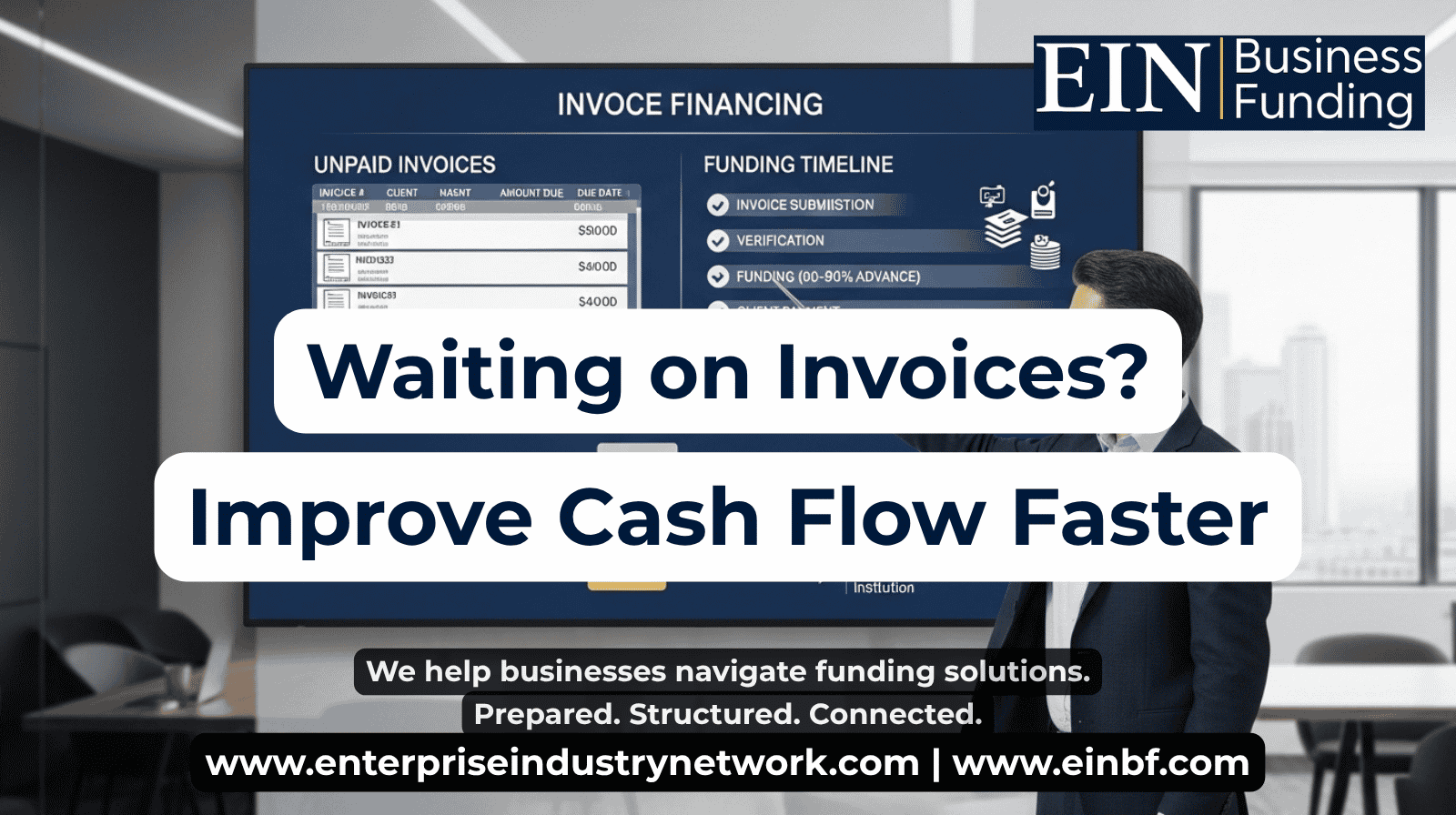 Featured image for the EINEdge article “Invoice Financing Strategy: How Businesses Turn Unpaid Invoices Into Working Capital.”
The image represents a business using eligible accounts receivable to access capital before customers reach their normal invoice payment dates, helping bridge the timing gap between completed work and incoming cash.
The accompanying EIN Business Funding long-form educational video explains how invoice financing can support payroll, inventory, suppliers, taxes, large orders, and other operating needs while customers are still paying on commercial terms.
The article also examines advance rates, invoice aging, customer creditworthiness, concentration risk, disputed invoices, financing costs, recourse and non-recourse structures, customer notification, collections, liens, eligible receivables, and the differences between invoice financing, factoring, business lines of credit, and working-capital loans.
This content supports users researching invoice financing, accounts receivable financing, unpaid invoice funding, business cash-flow financing, receivables advances, invoice factoring alternatives, invoice aging, customer-payment delays, and working-capital strategies.
EIN Business Funding (EINBF) is part of Enterprise Industry Network (EIN).